

A Betweenplays Media Inc. Editorial Feature
By COO & Editor-in-Chief Sandeep Panesar
WHEN A STAR INTERRUPTS A FLIGHT PATH — THE FREEFALL
On October 30th, 2025, a JetBlue Airways Airbus A320 flying from Cancún to Newark experienced a sudden, violent, and uncommanded pitch-down. Passengers and crew were thrown from seats; drinks and electronics hit the ceiling. Fifteen people reportedly suffered injuries before the aircraft diverted to Tampa and landed under emergency protocols. What appeared at first glance to be a distressingly familiar mid-air incident — one that could have been attributed to turbulence, pilot mis-trim, or mechanical failure — quickly revealed itself to be something unprecedented.
Within days, Airbus launched a forensic investigation. Within weeks, EASA and the FAA began coordinating emergency actions; and by the end of November, Airbus publicly disclosed what its engineers had quietly discovered: the aircraft’s flight-control computer had likely suffered a solar-radiation-induced Single Event Upset (SEU). A single neutron — a sub-atomic particle born in a solar flare millions of kilometers away — appears to have struck a vulnerable memory location inside the aircraft’s Elevator and Aileron Computer (ELAC), silently flipping a bit in a non-ECC-protected buffer and altering a leaf-level parameter governing elevator behavior.
“Analysis of a recent event involving an A320 Family aircraft has revealed that intense solar radiation may corrupt data critical to the functioning of flight controls,” Airbus wrote in its official press release (Airbus, 2025).
Editors note: I point out that there are alternate views on what happened and I explore them further down in this editorial.
The implications were enormous. One flipped bit had produced a global recall affecting approximately 6,000 Airbus A320-family aircraft, representing more than half of the active worldwide fleet (Reuters, 2025). Airlines scrambled. Regulators mobilized. Markets reacted. Telecommunications networks — despite sharing the similar solar exposure — remained unaffected. And the public heard only fragments of a story far more complex and consequential than any headline could capture.
Editor’s Note: I reached out to both Airbus and JetBlue for comment on the incident and received no response by the time of this publication. As a result, this article is written without their inputs. Should requests for interview be fulfilled I will update this article and date stamp the update.
THE SOLAR FLARE: A QUIET BURST WITH REAL CONSEQUENCES
A solar flare is an abrupt, explosive release of electromagnetic and particulate radiation from magnetically active regions of the Sun. These eruptions accelerate protons and ions to near-relativistic speeds, launching them toward Earth. Upon penetrating the upper atmosphere, they create cascades of secondary neutrons, which reach peak intensity at typical commercial flight altitudes between 30,000 and 40,000 feet.
Neutrons differ from the more familiar charged particles of solar storms. They do not interact strongly with atmospheric electric fields and therefore penetrate materials far more effectively. When one of these particles collides with a semiconductor, it can deposit enough charge to flip a bit inside digital memory. This phenomenon — the SEU — leaves no physical damage. No burn mark. No melted circuit. Only a silent but consequential change in logic.
In recent years, researchers have warned that shrinking semiconductor geometries make modern electronics increasingly vulnerable to SEUs, particularly in avionics exposed to elevated radiation environments. As one scientific review put it, “Single-event effects (SEEs), which are mainly induced by neutron particles, can be responsible for soft errors in avionics equipment” (Science in School, 2023).
But until October 2025, the aviation world had never confirmed a catastrophic control-law deviation arising from a solar neutron hitting a digital flight-control computer in a commercial airliner.
That changed with the JetBlue incident.
Editor’s Note: Neutrons — not neutrinos — are known to cause radiation-induced bit flips in electronics; neutrinos interact so weakly with matter that they pass through aircraft and computers without effect (CERN; NASA; IEEE).
INSIDE ELAC: THE BIT THAT BROKE THE SKY
The Airbus A320-family is a fly-by-wire aircraft, where pilot commands are mediated through electronic computers. One of the central components in this system is the ELAC — Elevator and Aileron Computer. It interprets pilot input and sensor data, applies control laws developed from aerodynamic models, and issues actuator commands governing pitch and roll.
In the incident aircraft, a neutron strike appears to have flipped a single bit in a leaf-level control-law parameter stored in a non-ECC-protected region of memory — a location considered low-risk for decades. The corrupted parameter remained numerically plausible; it fell within expected limits and therefore survived every range and sanity check in the ELAC’s input pipeline. Worse, because Airbus’s redundancy system expects that agreement equals validity, all ELAC channels loaded the same parameter from the same upstream buffer.
The system, seeing perfect consensus among all redundant lanes, interpreted the corrupted value as correct.
The aircraft then pitched down sharply.
The Guardian reported that “…the issue, traced to the Elevator and Aileron Computer (ELAC), was linked to a software vulnerability affected by solar radiation, potentially compromising flight control data” (The Guardian, 2025).
Millions of A320 flight hours had passed since the aircraft’s introduction in 1988 without any such event. But the chain of conditions required — a solar flare, a neutron strike, a vulnerable memory cell, a plausible corrupted value, and a specific flight regime — that finally arrived.
BREAKOUT: LEAF-LEVEL CONTROL-LAW PARAMETER AND NON-ECC — IN PLAIN ENGLISH
Editor’s Note: This explanation is a little more technical so if this does not hold your interest you can skip ahead and your reading of the article will not be impacted.
Modern aircraft like the Airbus A320 do not respond directly to pilot stick movements. Instead, computers interpret those inputs using a set of mathematical rules called control laws. Think of these control laws as a large decision tree that determines how much the aircraft should pitch, roll, or trim in response to what the pilot and sensors are doing.
For example, how the aircraft behaves during takeoff versus cruise. As the tree branches downward, the rules become more specific. At the very bottom of the tree are the smallest tuning values — tiny numerical settings that fine-tune how strongly the aircraft responds in a particular situation. These smallest values are called leaf-level parameters.
In this case, one of those fine-tuning values was stored in a part of the computer’s memory that did not have built-in error correction (referred to in this article as non-ECC). Most critical aircraft data is stored in special memory that can automatically detect and fix tiny errors caused by radiation. This particular parameter was not — because it was historically considered too minor to pose a safety risk.
When a high-energy particle flipped a single bit in that memory location, the value changed slightly but remained within what the computer believed was a “normal” range. Because the number still looked valid, the flight-control system accepted it and used it — even though it was wrong.
That is how a very small, low-level number — buried deep inside the flight-control logic — was able to influence how the aircraft moved.
HOW FAR THE AIRCRAFT WENT THROUGH FREEFALL
The exact altitude drop during the JetBlue event remains officially undisclosed because no detailed public summary of the flight-data recorder has yet been issued (at the time of this article’s writing).
Multiple reputable media outlets confirm a “sharp” and “uncommanded” loss of altitude sufficient to injure passengers (Al Jazeera, 2025).
One tabloid-style outlet claimed the aircraft fell “from 35,000 feet to 10,000 feet” — but this assertion remains unverified and is not supported by any regulator or manufacturer statement.
When I questioned an airline pilot and a pilot trainer they both doubted that the flight dropped more than 100 feet and would not comment on the validity of it being a neutron from a solar flare or something else that caused the event.
While the drop doesn’t seem like it’s much I was assured that a sharp instantaneous drop of that height would have been cause for concern by the pilots and terrifying for the passengers and other cabin crew.
What is known — and what Airbus and regulators treat as significant — is that the pitch-down was violent enough to cause passengers to be thrown upward into cabin structures, a hallmark of a rapid altitude deviation.
The technical cause matters far more than the precise magnitude: a flight-control upset occurred without pilot command because corrupted ELAC data actively moved control surfaces.
That alone changed aviation history.
WHY ONLY ONE AIRBUS EXPERIENCED THE FAILURE
The world’s airliners did not suddenly become vulnerable to cosmic events. Rather, this incident occurred because a series of improbabilities converged:
- The neutron flux at altitude must spike at precisely the wrong time.
- The neutron must strike a specific, unprotected memory cell.
- The corrupted value must remain numerically valid.
- Redundant channels must ingest it before checks for and detects anomalies.
- The aircraft must be in a control-law mode sensitive to the affected parameter.
- The flight-state geometry must amplify the corrupted input into actuator motion.
This was not a design flaw in the usual sense — it was a blind spot exposed by an exceptionally rare confluence of physics and software architecture.
THE FIX — AND WHY THE WORLD WAITED SO LONG TO HEAR ABOUT IT
Airbus’s eventual solution included both software and hardware modifications. The immediate fix involved rewriting ELAC memory maps so that all control-law parameters reside only in ECC-protected memory. The software update also introduced “semantic plausibility” checks that evaluate not simply whether a parameter is numerically in range, but whether it matches expected aerodynamic behavior and flight-state context.
Older ELAC units, particularly those using legacy semiconductor architectures, require hardware replacement or enhanced shielding. These retrofits take days, not hours.
Why the delay in public disclosure? Because Airbus could not announce a cause until it had ruled out all other possibilities, verified the failure path across redundant channels, reconstructed parameter behavior from flight data, briefed regulators, validated fixes in simulation and hardware loops, and confirmed that the solution would close the vulnerability definitively. Aviation does not tolerate speculative failure analysis; the wrong explanation can cause panic, litigation, and global grounding.
In short, the truth requires proof.
THE DAY THE WORLD’S A320 FLEET PAUSED
On November 28, 2025, Airbus issued an extraordinary notice: more than 6,000 A320-family aircraft worldwide required immediate repair. Many would receive only a short software update; others would need hardware changes. EASA responded with an Emergency Airworthiness Directive, mandating compliance before further flight. Airlines across Europe, Asia, and the Americas began grounding aircraft in waves.
Reuters reported:
“Europe’s Airbus said on Friday it was ordering immediate repairs to 6,000 of its widely used A320 family of jets in a sweeping recall affecting more than half the global fleet.”
(Reuters, 2025)
American Airlines confirmed that more than 200 of its aircraft required updates. Japan’s ANA canceled flights. India’s IndiGo — the world’s largest A320neo operator — accelerated patch schedules across multiple maintenance hubs. Singapore’s Scoot confirmed twenty-one aircraft impacted.
A neutron in a memory cell may have caused a global operational shockwave.
AIRBUS STOCK MOVED
On the day of the JetBlue incident, Airbus (AIR.PA) traded near €216–€217. As rumors of a fleet-wide issue surfaced, the stock slipped toward €202 by late November — a reflection of investor anxiety surrounding potential grounding costs, operational disruption, and manufacturer liability (Trading Economics, 2025). After the official announcement, the stock partially recovered into the €206–€210 range, as investors assessed the fix as manageable and the long-term order backlog intact (Yahoo Finance, 2025).
Some analysts maintained target prices near €220, arguing that Airbus’s strong fundamentals and global demand for A320-family aircraft supersede short-term turbulence (MarketScreener, 2025). Still, the market demonstrated that a digital upset in a flight-control computer could impact aerospace equities across continents.
A GLOBAL SHOCK TO SCHEDULES AND BALANCE SHEETS
Airlines operating A320-family aircraft experienced varying levels of disruption. Those with younger fleets and large maintenance infrastructures restored operations quickly. Others — particularly budget and regional carriers in Asia and Europe — struggled.

ANA canceled dozens of flights in Japan. Scoot publicly confirmed aircraft grounding in Singapore. American Airlines and United accelerated maintenance rotations, while JetBlue and Spirit executed patch cycles under FAA oversight. In India, where A320s serve as the backbone of domestic air travel, IndiGo restructured flight rotations across multiple hubs to absorb downtime.
The stock impact was uneven. Airlines heavily dependent on A320s saw short-lived dips, while diversified carriers remained relatively insulated. The true financial impact will be tallied over coming quarters as compensation, maintenance, cancellation, and revenue data become public.
The lesson is clear: space weather is now an operational risk factor embedded in airline economics.
WHY TELECOM DIDN’T BLINK
The world’s telecommunications networks faced the same solar flare, the same elevated neutron environment, and the same digital fragility — yet not a single major telecom outage was attributed to the October event.
Why? Because telecom systems sit beneath the atmospheric shield, where neutron flux is orders of magnitude lower. Carrier-grade switch and router architecture universally employ ECC memory and detect-and-correct logic. Telecom networks are distributed and asynchronous: a flipped bit results in a retransmission, not actuator deflection.

Telecom’s vulnerabilities during solar events are different: geomagnetic induced currents, GPS timing disturbances, and satellite anomalies. None reached critical thresholds during the October flare.
Aviation lost control for seconds because its logic loops map directly to physical movement. Telecom never felt a tremor because its loops map to data, not physics.
WHY THE MEDIA MISUNDERSTOOD THE STORY
Media outlets reported cancellations, recalls, and grounded fleets. But the narrative was simplified into “software glitch” headlines. The science — semiconductor physics, redundancy coherence, solar particle cascades — rarely made it into print.
Reuters captured the scale. The Guardian captured the cause. But almost no mainstream outlet connected the dots between solar activity, semiconductor vulnerabilities, and the digitization of flight control.
The story was too technical, too invisible, and too uncomfortable: the idea that a star can intervene in a flight-control computer unsettles the public imagination.
This article exists to fill that gap.
WAS IT REALLY A SOLAR FLARE?
When Airbus announced that “intense solar radiation” may have corrupted data in an A320-family flight-control computer (Airbus, 2025), most media outlets accepted the explanation at face value. But not everyone in the aviation world agrees. In the weeks following the JetBlue incident, pilots, avionics trainers, radiation physicists, and former airline captains began raising quiet but serious doubts about whether the event was triggered by a solar flare — or whether the industry may be confronting a deeper, unresolved vulnerability in the A320’s digital logic.
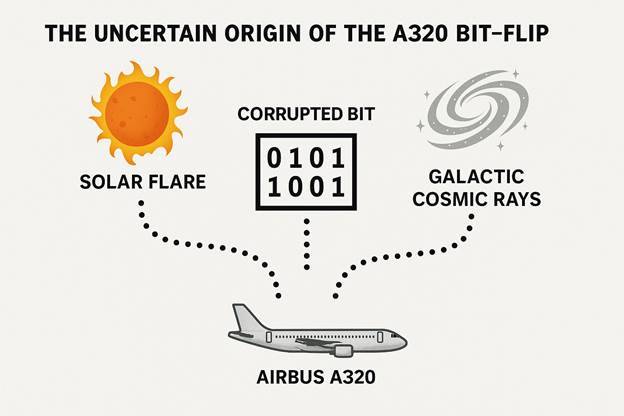
A radiation scientist interviewed about the event challenged the solar-flare narrative outright, noting that solar activity on October 30th was relatively modest: “It was more likely caused by a cosmic ray event than solar radiation,” explained Clive Dyer, a respected space-environment researcher (People, 2025). Dyer and others argue that galactic cosmic rays, which carry energies far exceeding those of typical solar-proton events, could have produced the bit-flip observed — especially since such particles are known to generate SEUs in avionics.
The skepticism deepened when several airline technical staff and pilot trainers reported that the so-called “fix” applied to thousands of A320s resembled a rollback to a previous software version, rather than a targeted, radiation-hardening update. Such reversions — reportedly completed in as little as two hours for many aircraft (The Guardian, 2025) — suggest that Airbus may have reverted to a more conservative flight-control logic path rather than fundamentally eliminating a hardware-level vulnerability.
One former Qantas captain publicly questioned whether the radiation explanation was “too convenient,” arguing that the absence of a publicly available flight-data summary makes it impossible to independently verify the claim (The Australian, 2025).
Editor’s Note: Investigations into these types of events by airlines, manufacturers and agencies are long and thorough, so there is no final confirmation of what happened whether neutron or software glitch or software roll back. We will not know the full extent of what happened on that JetBlue flight for a long time. Many final reports take over a year to produce exacting detail and recommendations on corrective actions. When that report comes out there will be an update to this article with a datestamp to it.
Because SEUs leave no burn marks or physical damage, only digital traces remain. And with no FDR or ELAC memory data released, the evidence sits entirely inside Airbus, EASA, and the NTSB. This opacity fuels uncertainty — especially given historical precedents in which radiation was initially blamed for aircraft anomalies but later ruled out after exhaustive examination.
What remains is a technical standoff.
Until more data emerges, the true origin of the bit-flip remains unresolved. For now, the world is left with two possibilities — one astrophysical, one architectural — and a reminder that in the age of digital flight, the smallest uncertainties can scale into global consequences.
The particle implicated in radiation-induced bit flips is a neutron, not a neutrino. Neutrons can interact with semiconductor memory and change stored data; neutrinos pass through matter almost entirely without effect.
A SINGLE BIT AND THE PRICE OF DIGITAL TRUST
One neutron — a traveler from the Sun’s turbulent surface — might have struck a memory cell inside an aircraft streaking across the sky, and that same aircraft may have been affected by a software glitch. Regardless the event produced a flipped bit that should not have mattered and exposed a blind spot in the digital skeleton of modern aviation. It triggered a global recall/software update or rollback, grounded thousands of jets, injured passengers, moved markets, and reminded the world that physics remains the ultimate stakeholder in digital safety.

Telecom survived untouched. Aviation adapted. Investors recalibrated. But the lesson remains: as humanity entrusts more of life to code, we must accept that cosmic, quantum, and entropic forces shape our systems in ways we can no longer ignore.
Betweenplays will continue to report on the stories others oversimplify — the stories where physics, technology, markets, and human safety intersect.
Editor’s Note: This is article was created as balanced as possible with the available information at the time of press. The pilot wished to remain anonymous, and the information from the pilot trainer came through a 3rd party for identity protection purposes. They are both trusted sources and both work for major global airlines. We will continue to update this article as new information is released.
Glossary
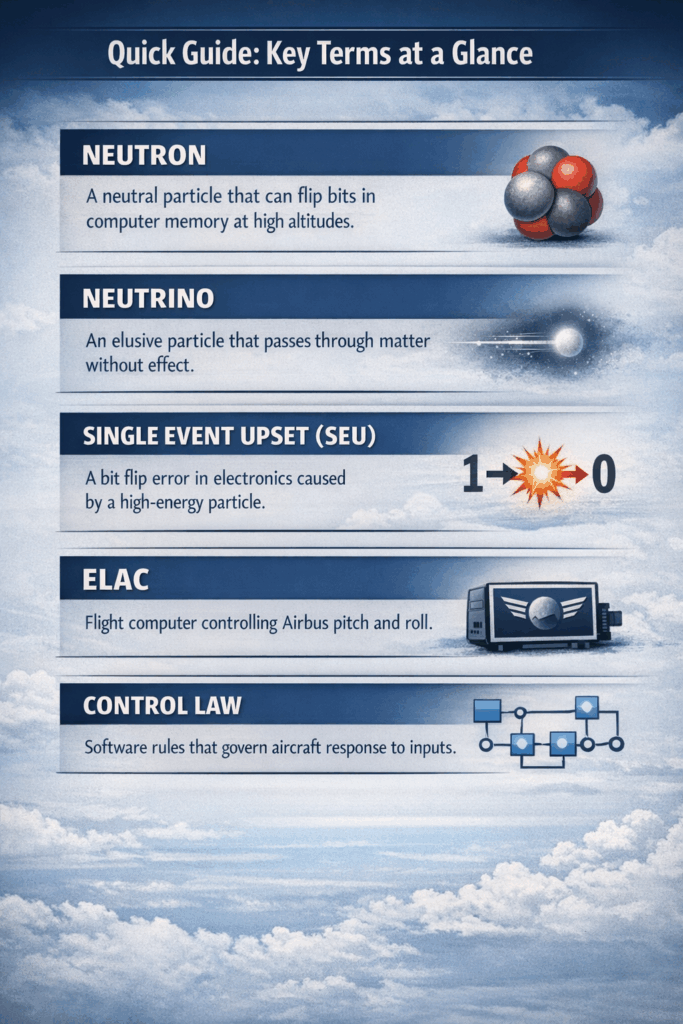
So we understand the terminology here is a little infograph that goes along with the definitions below.
Neutron
A neutral subatomic particle that can interact with computer memory and flip digital bits, sometimes causing electronic errors in aircraft at high altitude.
Neutrino
An almost massless particle that passes through matter with virtually no interaction and does not affect aircraft or telecom electronics.
Single Event Upset (SEU)
A temporary data error caused when a high-energy particle flips a single bit in electronic memory without damaging the hardware.
ELAC (Elevator and Aileron Computer)
A flight-control computer in Airbus aircraft that manages pitch and roll using fly-by-wire logic.
Control Law
The software rules that determine how an aircraft responds to pilot inputs and flight conditions.
Additional Freefall Reading (if you’re interested and you should be!)
CERN — “What is a Neutrino?”
🔗 https://home.cern/science/physics/neutrinos
It implicitly contrasts neutrinos with particles like neutrons that do interact with matter.
NASA — Cosmic Rays and Secondary Particles
🔗 https://helios.gsfc.nasa.gov/cosmic.html
This is one of the clearest sources establishing neutrons as the particle of concern in aviation electronics.
IEEE Spectrum — “Why Cosmic Rays Flip Bits in Computers”
🔗 https://spectrum.ieee.org/cosmic-rays-computers
This is an excellent bridge between physics and systems engineering.
Fermilab — Neutrinos Explained
🔗 https://neutrinos.fnal.gov/sources/solar-neutrinos/
If neutrinos can’t trigger detectors the size of buildings, they cannot flip a bit in avionics memory.
REFERENCES
Airbus. (2025, November 28). Airbus update on A320 Family precautionary fleet action. https://www.airbus.com/en/newsroom/press-releases/2025-11-airbus-update-on-a320-family-precautionary-fleet-action
Al Jazeera. (2025, November 28). Airbus issues major A320 recall after flight-control incident. https://www.aljazeera.com/economy/2025/11/28/airbus-issues-major-a320-recall-after-flight-control-incident
MarketScreener. (2025). Airbus: RBC raises target price. https://www.marketscreener.com/news/airbus-rbc-raises-target-price-ce7d58dad98af323
Reuters. (2025, November 28). Airbus issues major A320 recall after flight-control incident. https://www.reuters.com/business/aerospace-defense/airbus-issues-major-a320-recall-after-flight-control-incident-2025-11-28
Science in School. (2023). Particle physics and aviation safety. https://scienceinschool.org/article/2023/particle-physics-aviation-safety
The Guardian. (2025, November 28). Airbus issues major A320 recall after recent mid-air incident. https://www.theguardian.com/business/2025/nov/28/airbus-issues-major-a320-recall-after-recent-mid-air-incident
Trading Economics. (2025). Airbus stock historical data. https://tradingeconomics.com/air:fp
Yahoo Finance. (2025). AIR.PA – Airbus SE share price & history. https://finance.yahoo.com/quote/AIR.PAPrimary, Plain-Language Source (Best All-Around)
 Andrea Turno
  Albert Laurin