

Why the Greenland Invasion Narrative Keeps Returning
Every few weeks, the same headline flares back to life: What if the United States really tried to take Greenland? It sounds like satire until it doesn’t. The Greenland fear did not come from nowhere. It rests on trends that are real. Alliances feel more transactional than they used to. From tariff threats to defense burden fights, recent years have shown that even long-standing relationships are no longer sacred. In a world where Crimea happened, Gaza exploded, and Red Sea shipping turned into a war zone almost overnight, even the most outlandish geopolitical ideas no longer feel safely absurd. So when politicians speak about Greenland in blunt, imperial language, it hits a raw nerve. It sounds like a prelude. But plausibility is not probability. When you move from vibes to mechanics, the Greenland occupation scenario collapses quickly.
Fixating on a US invasion of Greenland is a category error. It mistakes rhetorical shock value for operational reality. And worse, it pulls attention away from the Arctic flashpoints that actually have the ingredients for a real crisis very soon.
The Arctic is no longer a frozen backwater. Arctic geography and resources genuinely matter more than they did a decade ago. The High North is now central to missile warning systems, undersea data routes, and great-power competition over shipping lanes and critical minerals. What happens next is far more likely to involve a “research vessel” standoff, a cable cut in the dark, or a freedom-of-navigation clash than a flag-planting occupation of a NATO territory.
Strip away the vibes and the cable-news drama, and a military occupation of Greenland this year is not just unlikely. It is near-zero probability, based on how US politics, NATO law, military logistics, and strategic incentives actually work. Not because leaders are always rational. Not because norms always hold. But because the machinery required to do this simply does not exist right now.
Start with the political reality. For a forced takeover to happen this year, Washington would already have to be in motion across multiple visible channels. You would see a formal or de facto declaration of military action. You would see emergency funding requests. You would see classified Congressional briefings leaking into major outlets. You would see interagency coordination across Defense, State, Treasury, and Justice. You would see a legal narrative forming to justify force under international law, even though no such justification exists.
None of that is happening.
There are no troop mobilizations. No legislative groundwork. No legal signaling. No Pentagon narrative priming. Those indicators always show up months in advance. They are bureaucratic. They are structural. They are impossible to hide.
Then there is the alliance reality. Greenland is not some legal gray zone. It is part of the Kingdom of Denmark. Denmark is a NATO member. A US occupation would instantly trigger NATO emergency consultations, shatter alliance cohesion, and amount to Washington attacking its own security architecture.
Every US base in Europe would become politically vulnerable overnight. The credibility of every US security guarantee, from Eastern Europe to East Asia, would crater. In one move, Washington would hand its rivals proof that its treaty commitments are conditional and reversible.
No US administration, regardless of ideology, or benefits from that outcome would attempt this. It is a strategic self-own with no upside.
The logistics reality is even harsher. An operation like this cannot be improvised. A Greenland occupation would require amphibious lift and airlift staging, pre-positioned supplies in the North Atlantic, host-nation basing agreements that Denmark would never grant, ice-capable naval assets in unusual numbers, and Arctic intelligence, air-defense suppression, and sustainment planning.
None of this is observable.
The US cannot hide that scale of movement. Carrier groups, sealift ships, tanker aircraft, Arctic brigades, and logistics hubs leave unmistakable fingerprints. Nothing remotely like that is happening. If Greenland were genuinely on the operational calendar, the North Atlantic would already look very different.
It does not.
There is also no strategic necessity forcing the issue. The US already operates Pituffik Space Base. It already has missile warning radar coverage. It already has Arctic access agreements and intelligence cooperation with Denmark. It already controls the North Atlantic sea lanes through NATO.
In practice, Washington already has what it needs.
If it wants more Arctic presence, it can get it the way it always does: through negotiation, basing agreements, infrastructure investment, and political leverage. That path is slower and less theatrical, but far more effective. There is no military gap that invasion solves better than diplomacy.
And then there is the domestic reality. A war against Denmark would detonate US politics. It would trigger mass protests, crash markets, collapse approval ratings, split the military and intelligence community, and generate nonstop impeachment or constitutional-crisis dynamics.
Even for an administration willing to break norms, this is politically non-executable. It would consume the presidency and paralyze governance for the remainder of the term.
Which leaves only the realistic Greenland scenarios. Quiet negotiations for expanded basing rights. Economic pressure plus infrastructure and mining investment to reduce Danish leverage. A long-game diplomatic autonomy push, backing Greenlandic independence so a future sovereign state signs deeper security deals with Washington.
All of those are slow, deniable, and legally survivable.
Military occupation is none of those.
So yes, Greenland makes for a dramatic story. But drama is not where geopolitical systems usually break. They break in gray zones, in legal ambiguities, and in infrastructure no one notices until it fails.
The Arctic is no longer a frozen backwater. It is a dense web of shipping corridors, missile warning systems, undersea cables, treaty loopholes, and military red lines, now melting into navigability faster than diplomacy can keep up. What happens there next is far more likely to involve a “research vessel” standoff, a cable cut in the dark, or a freedom-of-navigation clash than a flag-planting occupation of NATO territory.
Which brings us to the places that actually matter.
Flashpoint One: Svalbard and the Barents Sea
The most legally ambiguous piece of Arctic territory is not Greenland. It is Svalbard.
The 1920 Svalbard Treaty recognizes Norwegian sovereignty over the archipelago but also grants non-discriminatory access and economic rights to treaty parties, while placing limits on militarization. That creates a persistent zone of disagreement over what “allowed” presence and enforcement look like in practice.
In recent years, Russia has increasingly framed Norway’s governance and security posture as treaty violations, while Norway insists it is acting within the treaty framework. In March 2025, Russia accused Norway of militarizing Svalbard and summoned Norway’s ambassador; Oslo rejected the claim and reaffirmed its interpretation of treaty obligations.
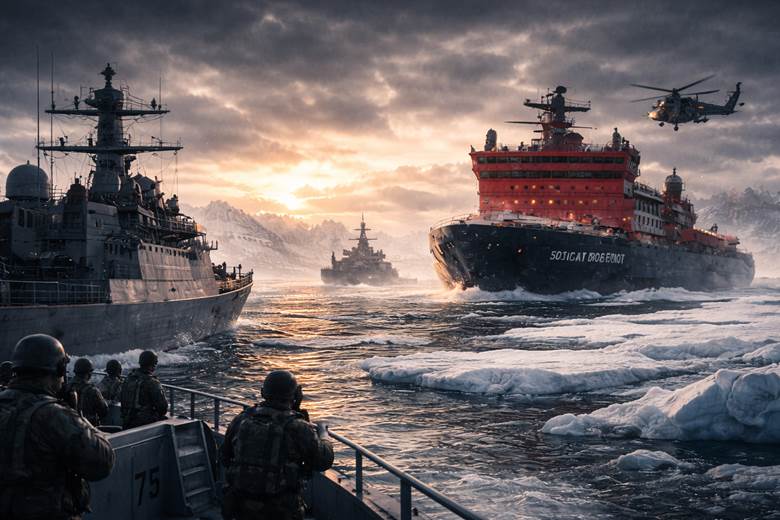
This kind of dispute is dangerous because it has three accelerants:
- Treaty ambiguity
- Proximity to strategic waters in the Barents Sea, central to Russian naval posture
- Crisis triggers that look small: port access, research permits, shipping inspections
The escalation path is straightforward. A contested “civilian” move, Norwegian enforcement action, Russian asymmetric response, NATO emergency consultations. A legal footnote becomes a geopolitical crisis.
Flashpoint Two: The Northern Sea Route
As ice retreats, the Northern Sea Route becomes one of the world’s most consequential legal fights over maritime control.
Russia treats the route as a national transport corridor subject to its domestic regulatory regime and requires foreign vessels to seek permission and carry Russian pilots. This is not informal posturing. It is codified in Russian law and policy statements.
Western governments view key elements of this regime as inconsistent with international navigation norms. The result is a structural collision between coastal state authority and freedom-of-navigation claims.
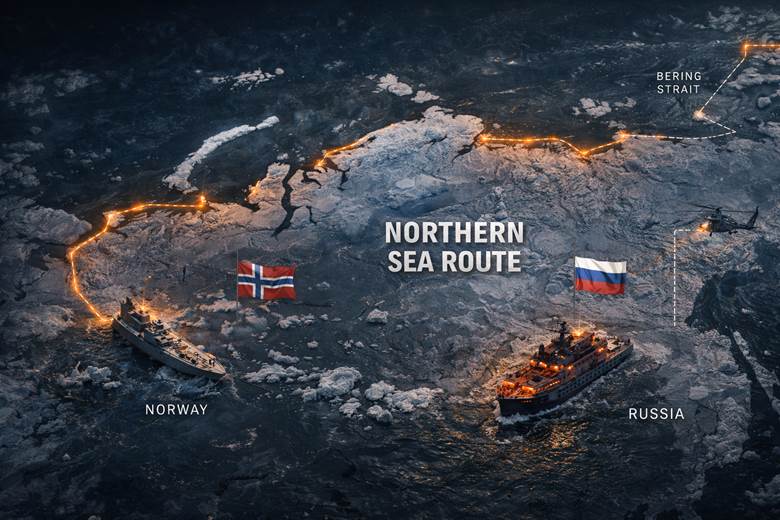
The escalation pathway is simple:
- A foreign naval vessel conducts a transit aligned with its interpretation of navigation rights.
- Russia attempts to impose control through escort demands or shadowing.
- A standoff forms.
- A collision or diplomatic rupture follows.
This is South China Sea logic transplanted into a far more fragile environment.
Flashpoint Three: Undersea infrastructure sabotage
If you want the highest-probability Arctic-adjacent crisis driver this year, look down, not outward. Undersea cables and energy links are vital, vulnerable, and hard to defend. When they break, attribution is often murky, and that uncertainty creates the perfect escalatory environment.
Since Russia’s 2022 invasion of Ukraine, multiple power cables, telecom links, and pipelines in the Baltic and North Atlantic regions have been disrupted. In January 2026, Finnish police released a Russia-linked vessel held in a cable sabotage investigation, underscoring how difficult attribution remains even when suspicion is high.
The Financial Times has reported on NATO’s rising concern about undersea infrastructure vulnerability and increased surveillance in response to suspected sabotage.⁶ NATO has formally launched a mission called “Baltic Sentry” to increase protection of critical maritime infrastructure.⁷
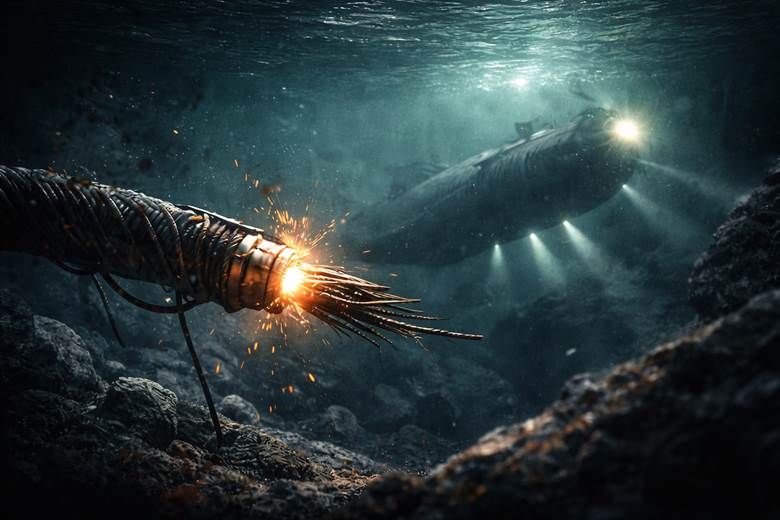
The escalation pathway here is especially dangerous:
- A major cable is damaged.
- Evidence is ambiguous but politically charged.
- Markets react.
- Naval deployments increase.
- Retaliatory cyber or sanctions measures follow.
- Each step is framed as defensive.
This is how crises start without anyone deciding to start one.
Why Greenland fixation is the wrong lens
The Greenland scenario is emotionally compelling because it is simple. It has a dramatic violation and a clean villain narrative.
But geopolitics rarely breaks where the public is staring. It breaks in gray zones: legal ambiguity, deniable sabotage, contested shipping regimes, and “civilian” moves with military implications.
Svalbard has treaty friction baked in. The Northern Sea Route has an active legal conflict tied to power projection. Undersea infrastructure offers plausible deniability and asymmetric leverage and is already generating incidents and NATO responses.
Greenland, by contrast, is legally clean and diplomatically integrated. The US has access without conquest, and a violent move would torch alliance credibility for no operational necessity.
What to Watch For Next
If the Arctic really is heading toward a crisis, the warning signs will not look like invasion headlines. They will look bureaucratic, technical, and boring until they are suddenly not.
Here are the real signals to track over the next 6–12 months.
Svalbard enforcement incidents
Watch for Norway denying port access, research permits, or cargo inspections to Russian-linked vessels. Any Russian detention, naval shadowing, or formal treaty protest tied to Svalbard is a serious escalation marker.
Northern Sea Route standoffs
Pay attention to Western naval or government vessels transiting the Northern Sea Route without Russian permission. A single escort demand, collision scare, or boarding attempt could trigger a legal and diplomatic spiral.
Undersea cable disruptions
Track unexplained outages in the Baltic, North Atlantic, or Arctic-adjacent waters. A major fiber cut or pipeline failure, especially near known Russian deep-sea activity zones, is the highest-probability flashpoint for a fast-moving crisis.
NATO infrastructure protection moves
Watch for expanded NATO naval patrols, new “critical infrastructure” task forces, or emergency summits focused on undersea security. These are not symbolic. They are reactive indicators that something already went wrong.
Arctic military posture shifts
Look for unusual deployments: ice-capable naval surges, Arctic brigades leaving training cycles, bomber or tanker forward deployments to Iceland or northern Norway, or sudden logistics exercises in the North Atlantic.
Treaty and legal rhetoric changes
Watch how often governments start invoking specific treaty clauses in public. When lawyers start replacing diplomats in press briefings, escalation is already underway.
The Bottom Line
The next Arctic crisis will not announce itself as a war. It will look like a shipping dispute, a research accident, or a broken cable.
Then the markets will react, the navies will move and the diplomats will panic.
By the time the headlines catch up, the damage will already be done.
References
Svalbard Treaty (1920). University of Oslo Faculty of Law. https://www.jus.uio.no/english/services/library/treaties/01/1-11/svalbard-treaty.html
Ulfstein, Geir. (2011). The Svalbard Treaty: From terra nullius to Norwegian sovereignty. Arctic Review on Law and Politics, 2(2), 2–21. https://arcticreview.no/index.php/arctic/article/view/2348/4675
Reuters. (2025, March 14). Russia accuses Norway of militarising Svalbard Arctic islands. https://www.reuters.com/world/europe/russia-accuses-norway-militarising-svalbard-arctic-islands-2025-03-14/
Ministry of Foreign Affairs of the Russian Federation. (2025). Definition of the Northern Sea Route and its legal regime. https://mid.ru/en/foreign_policy/aktual_nyye_voprosy_mezhdunarodnogo_prava_pozitsiya_rossii/2048391/
Todorov, Andrey. (2023, March 9). New Russian law on Northern Sea Route navigation: Gathering Arctic storm or tempest in a teapot? Belfer Center for Science and International Affairs, Harvard Kennedy School. https://www.belfercenter.org/publication/new-russian-law-northern-sea-route-navigation-gathering-arctic-storm-or-tempest-teapot
Reuters. (2026, January 12). Finland releases Russia-linked ship held in cable sabotage probe. Reuters.
 Andrea Turno
  Albert Laurin