
Harvest Now, Decrypt Later (HNDL) is Already Here
For decades, encryption has given us a comforting illusion. Once data is encrypted and stored, it is safe. Not just today, but indefinitely. That assumption is now quietly breaking.
Across governments, corporations, and intelligence agencies, a long-running strategy known as “Harvest Now, Decrypt Later” has moved from theoretical concern to operational reality. The idea is simple. Collect encrypted data today. Store it. Wait. When cryptography fails tomorrow, unlock everything at once. This is not about breaking encryption in real time. It is about patience, storage, and future math.
Now, thanks to advances in quantum computing and the slow pace of cryptographic migration, the payoff horizon is no longer science fiction.
The Long Game of Data Theft
Most cyberattacks are designed for immediate results. Ransomware encrypts files and demands payment. Phishing steals credentials for quick access. Data breaches monetize information as fast as possible.
Harvest Now, Decrypt Later plays a different game. In an HNDL scenario, attackers intercept or steal encrypted data they cannot currently read. Network traffic. Archived databases. Encrypted backups. VPN tunnels. Cloud storage. The attacker makes no attempt to decrypt it today. They only need to preserve it.
The value of the data lies in its future sensitivity: Diplomatic cables; Intelligence reporting; Healthcare records; Financial histories; Identity data; Proprietary research. If that information remains valuable ten, twenty, or thirty years from now, encryption that works today may not protect it forever.
This strategy is especially attractive because it is cheap. Storage is inexpensive. Interception infrastructure already exists. The hardest part is simply waiting.
Why Quantum Computing Changes Everything
Modern public-key cryptography relies on mathematical problems that classical computers cannot solve efficiently. RSA depends on factoring large numbers. Elliptic curve cryptography depends on discrete logarithms. These assumptions underpin TLS, VPNs, secure email, digital signatures, and authentication systems worldwide. Quantum computing breaks those assumptions.
Shor’s algorithm, first described in the 1990s, shows that a sufficiently powerful quantum computer could efficiently solve the problems underlying RSA and elliptic curve cryptography. Once such a machine exists at cryptographically relevant scale, many of today’s most widely used encryption and signature systems fail outright. Notably this event is called Q-Day in the industry.
There is no graceful degradation. One day the data is safe. The next day it is readable. That cliff edge is what makes HNDL so dangerous. When the break happens, it retroactively compromises decades of stored data. Encryption does not expire safely. It collapses.
From Academic Curiosity to Strategic Threat
For years, quantum threats to cryptography were treated as academic exercises. Quantum computers were “always twenty years away.” Security teams had more immediate problems to solve.
That mindset began to shift in the mid-2010s. Investment in quantum research accelerated. Governments classified quantum capability as a strategic priority. At the same time, data retention periods quietly expanded. Cloud storage normalized indefinite retention. Regulatory regimes encouraged preservation rather than deletion. Data became cheap to keep and expensive to lose.
By the early 2020s, security agencies began issuing warnings that waiting for quantum computers to arrive before acting was a mistake. If adversaries were already harvesting encrypted data, mitigation had to happen before that data was collected, not afterward.
HNDL reframed the question. The relevant timeline was no longer “When will quantum computers exist?” but “How long must this data remain confidential?”
For many categories of data, the answer is decades.
Post-Quantum Cryptography Arrives
One of the biggest barriers to action was the lack of trusted alternatives. Quantum-resistant cryptographic algorithms existed, but they were experimental, unstandardized, and often impractical to deploy at scale.
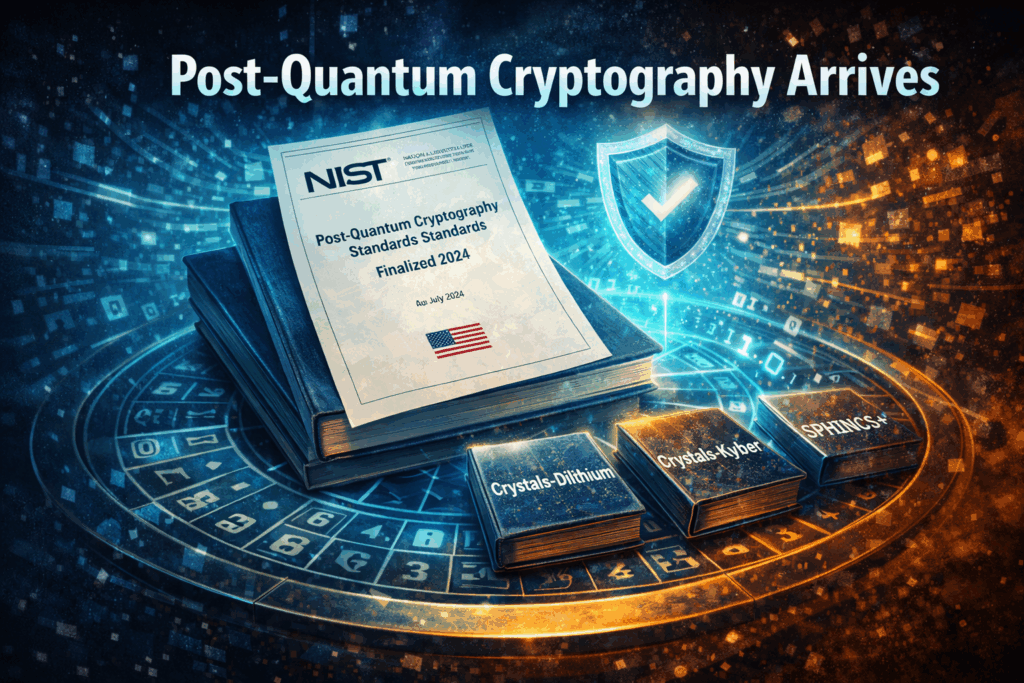
That changed in 2024. After nearly a decade of public evaluation, the National Institute of Standards and Technology finalized its first set of post-quantum cryptography standards. These algorithms are designed to resist both classical and quantum attacks, relying on mathematical problems believed to be quantum-hard.
This moment marked a turning point. HNDL was no longer a problem without a solution. Organizations now had standardized, vetted tools they could deploy. The challenge shifted from cryptography research to systems engineering, governance, and migration.
The Clock Is Shorter Than It Looks
Following the release of post-quantum standards, governments and regulators began publishing transition guidance. Many recommend phasing out vulnerable public-key algorithms by around 2030, with full deprecation by the mid-2030s.
Those dates may sound distant. In practice, they are alarmingly close. Cryptographic transitions are slow. Encryption is embedded everywhere, from browsers and operating systems to embedded devices, industrial controllers, and legacy enterprise software. Many organizations do not even have a complete inventory of where cryptography is used, let alone how to replace it.

HNDL compresses the timeline further. Every year that legacy cryptography remains in place is another year of data that can be harvested and stored by adversaries. Once collected, it cannot be recalled or re-encrypted. For data with long confidentiality requirements, delay is itself a vulnerability.
Who Has the Most to Lose
Not all data is equally exposed to HNDL. Short-lived session traffic or operational telemetry may lose relevance long before quantum decryption becomes practical.
Long-lived data is a different story. High-risk categories include government and military communications, intelligence archives, healthcare and genomic data, financial records, identity systems, legal documents, and proprietary research. In these cases, future disclosure could be more damaging than a breach today.
Digital signatures are also at risk. Quantum attacks against signature schemes could undermine trust in software updates, audit logs, contracts, and historical records. The impact is not just confidentiality, but integrity and non-repudiation. HNDL turns time into an attack multiplier.
Crypto-Agility Becomes Non-Optional
One lesson emerging from the HNDL threat is that cryptography cannot be treated as a fixed design choice. Systems must be crypto-agile.
Crypto-agility means the ability to replace cryptographic algorithms without rewriting entire systems. Historically, many platforms hard-coded algorithms and key sizes deep into protocols and applications. That approach worked when cryptographic lifetimes were measured in generations.
It fails under HNDL. Organizations that cannot change cryptography quickly face prolonged exposure during transitions. Those that design for agility can deploy hybrid schemes, test new algorithms, and migrate incrementally.
This is as much an organizational problem as a technical one. Crypto-agility requires governance, inventory management, vendor coordination, and long-term planning. It also requires accepting that cryptographic change is inevitable.
How Organizations Are Responding
Most organizations are not attempting an overnight switch to post-quantum cryptography. Instead, they are adopting phased strategies.
The first step is visibility. Cryptographic inventories identify where vulnerable algorithms are used and what data they protect. This often reveals surprising dependencies and forgotten systems.
Next comes prioritization. Data with long confidentiality lifetimes is addressed first. Systems that protect ephemeral data may follow later.
Hybrid cryptography is becoming a common transitional approach. By combining classical and post-quantum algorithms, systems remain secure even if one component is later broken. While not a permanent solution, hybrids reduce immediate HNDL exposure.
Vendor pressure is also increasing. Organizations are demanding post-quantum roadmaps from cloud providers, software vendors, and hardware manufacturers. Third-party dependencies are often the weakest link in cryptographic transitions.
What This Means for Individuals
HNDL is not just a government or enterprise problem. Individuals generate long-lived sensitive data through healthcare systems, cloud storage, messaging platforms, and digital identity services.
Most people cannot choose cryptographic algorithms directly. They rely on providers to make those decisions. As awareness of HNDL grows, pressure on platforms to adopt quantum-resistant security is likely to increase.
At a societal level, HNDL challenges assumptions about digital permanence. Decisions made today about encryption and data retention will shape privacy outcomes decades from now.
The Quiet Urgency of the Present
Harvest Now, Decrypt Later is not about panic. It is about realism. Quantum computers capable of breaking today’s cryptography may still be years away. But the data they will decrypt is being collected right now. Every encrypted packet intercepted today is a potential disclosure tomorrow.
With post-quantum standards finalized and migration timelines tightening, the window for preventative action is closing. Not because the future has arrived, but because the past cannot be changed.
Encryption has always been about buying time. HNDL forces us to ask a harder question. How much time do we actually have?
References
National Institute of Standards and Technology. “Post-Quantum Cryptography.”
National Institute of Standards and Technology. “NIST Releases First Finalized Post-Quantum Encryption Standards” (2024).
Mosca, M. “Cybersecurity in an Era with Quantum Computers: Will We Be Ready? https://eprint.iacr.org/2015/1075.pdf
Shor, P. “Algorithms for Quantum Computation: Discrete Logarithms and Factoring.” Proceedings of the 35th Annual Symposium on Foundations of Computer Science, 1994. https://ieeexplore.ieee.org/document/365700
CISA. “Preparing for Post-Quantum Cryptography.”
Government of Canada, Canadian Centre for Cyber Security. “Roadmap for the Migration to Post-Quantum Cryptography.”