

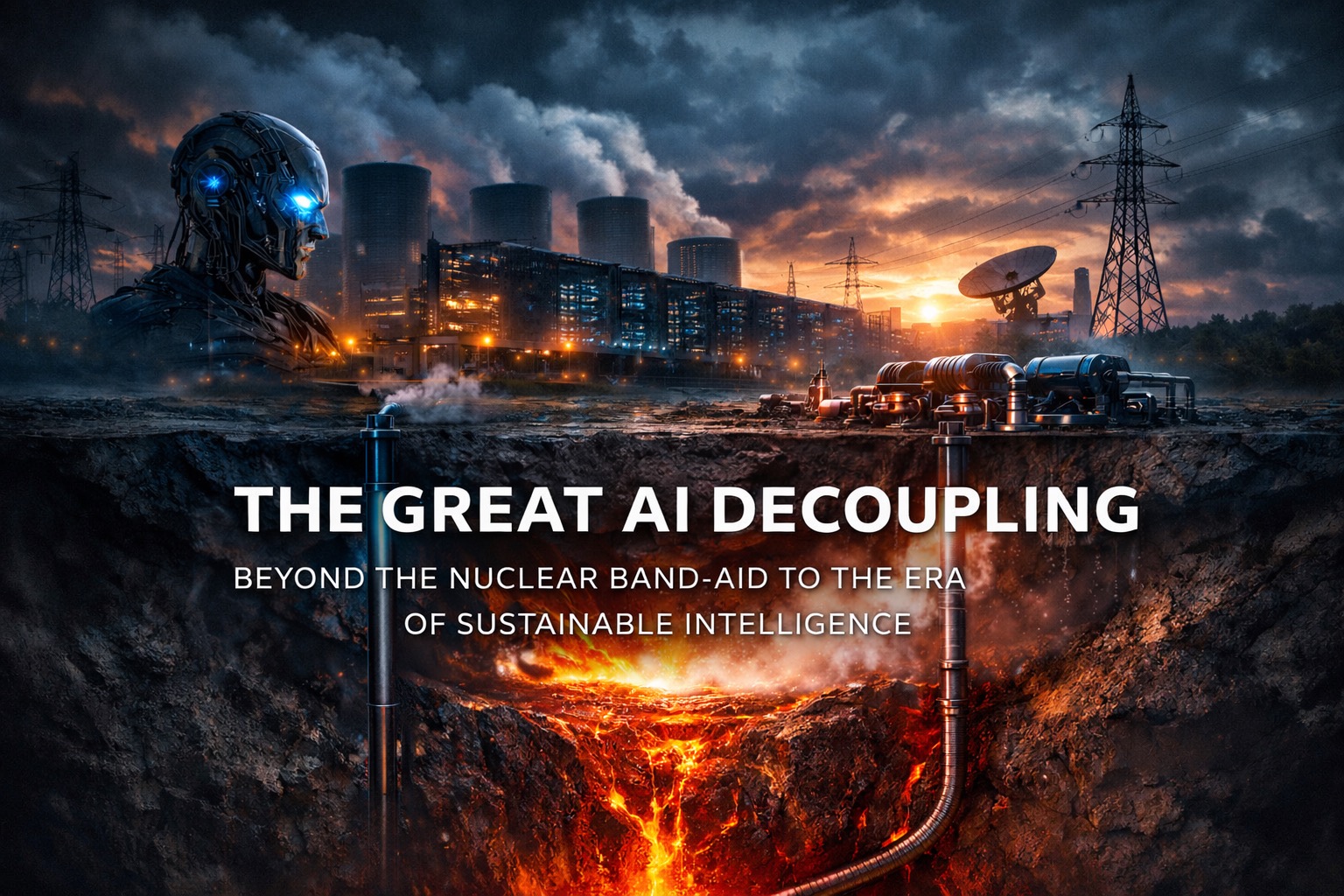
AI is not just a software wave; it is a thermodynamic event. As model scale and inference volume explode, the constraints are no longer GPUs and talent—they are megawatts, cooling loops, and time-to-power. The next decade belongs to the builders who decouple intelligence from energy intensity: by making compute radically more efficient, by treating heat as a first-class design variable, and by tapping firm, scalable baseload sources that don’t depend on a nuclear miracle.
The prevailing narrative in Artificial Intelligence has shifted from “how smart?” to “how much power?” As Generative AI scales, it has collided with a hard physical ceiling: energy consumption. The immediate reaction from Silicon Valley’s giants has been to turn back the clock to the atomic age. Microsoft, Google, and Amazon are racing to secure nuclear power deals, restarting shuttered plants to guarantee the gigawatts needed for their data centers.
But is brute-force energy generation truly the only path forward?
While nuclear power offers a necessary band-aid for the immediate “baseload” problem, a quieter, more radical revolution is brewing in the architecture of computing itself. Investors must recognize that the long-term winner of the AI race may not be the company with the most power plants, but the one that renders them unnecessary through Sustainable Intelligence.
The Core Conflict: The “Band-Aid” vs. The Cure
The current AI ecosystem relies on the Von Neumann architecture, a 1940s design where data must constantly shuttle between memory and processing units. This movement generates massive heat and latency, forcing data centers to run strictly synchronous, power-hungry clocks.
Nuclear power solves the supply side of this equation—providing carbon-free, 24/7 electricity to feed these inefficient chips. However, it does not solve the demand inefficiency. We cannot simply build infinite nuclear reactors to power inefficient chips; the capital and regulatory costs are too high. The true alpha lies in “Demand Destruction”—technologies that slash the energy required to perform a calculation by 1,000x.
The Great Efficiency Race: Evolution vs. Revolution
The race for sustainable AI is splitting into two distinct investment horizons: the Evolution of current tech, and the Revolution of new physics.
1. The “Safe” Transition: Optimizing the Incumbents
The giants are not standing still. NVIDIA is aggressively pivoting to “performance per watt” with its Blackwell architecture and software tools like “Power Profiles” to defend its moat. Meanwhile, Arm remains the undisputed king of efficiency at the edge. As AI moves from the cloud to phones and cars, Arm’s low-power hegemony (Ethos-U85) makes it the default standard, ensuring they capture value even if the data center market shifts.
2. The “Bridge” Builders: Solving the Bottleneck
A new class of private companies is emerging to solve the memory bottleneck without waiting for a total physics redesign.
- Groq: This startup has made waves by abandoning the GPU model for a “Language Processing Unit” (LPU). By relying on massive on-chip SRAM instead of slow external memory, Groq delivers blistering speeds—over 300 tokens per second on Llama 2 70B models—challenging the economics of standard GPUs (Source: Groq Benchmark).
- Tenstorrent: Led by legendary chip architect Jim Keller, Tenstorrent recently closed a $693M Series D to build modular RISC-V AI computers. Their chips strip away legacy bloat, offering a more customizable and efficient alternative for hyperscalers (Source: Tenstorrent Press Release).
3. The Disruptors: Analog & Neuromorphic Computing
The most asymmetric opportunities lie in architectures that mimic nature.
- Analog In-Memory (Sagence AI): By performing math inside the memory cells using continuous signals, chips from companies like Sagence AI eliminate the high energy cost of moving data. This promises potential for 100x lower power consumption than digital approaches.
- Neuromorphic (BrainChip, Innatera): These chips are “event-driven,” meaning they only consume power when data changes—much like the human brain. Intel’s Hala Point research system has demonstrated efficiency gains of up to 12x over conventional systems. BrainChip and Innatera are commercializing this for the “Edge,” putting intelligence into always-on sensors that run on batteries.
4. The Green Cloud: Decoupling from the Grid
Until hardware efficiency catches up, infrastructure plays like Crusoe are vital. They build data centers directly at the source of stranded energy (like flared gas or remote renewables), effectively “decoupling” AI compute from the strained public grid.
The brutal math: power is now the limiter
Data centers are already a material share of electricity demand in the United States, and their consumption is forecast to rise sharply as AI workloads take over the IT mix. The pressure point is not only generation—it is delivery (grid capacity) and rejection (cooling).
Cooling alone can range from roughly 7% of total electricity use in efficient hyperscale facilities to 30%+ in less-efficient enterprise sites. That spread is the proof: efficiency choices matter.
“AI isn’t just compute anymore. It’s a power-permitting problem.”
Source: International Energy Agency (2025), Energy and AI (PDF) and Pew Research Center (2025), What we know about energy use at U.S. data centers amid the AI boom
Why the SMR narrative won’t carry AI in the long run
Small modular reactors (SMRs) are the perfect story for a power-hungry era: compact, firm, and theoretically replicable. But the SMR thesis collides with four realities that don’t bend for hype: economics, supply chain, licensing timelines, and the opportunity cost versus alternatives.
- FOAK economics are still brutal. Building “small” doesn’t automatically mean building “cheap.” First-of-a-kind nuclear projects carry high uncertainty, and serial “economies of multiples” only materialize after standardized manufacturing, repeat siting, and a stable order book—conditions that are not yet proven in the Western SMR market.
- Fuel is a gating constraint. Many advanced/SMR designs require HALEU fuel. The U.S. Department of Energy explicitly notes that HALEU is not currently available from domestic suppliers and that supply gaps can delay advanced reactor deployment.
- Licensing modernization helps—but does not erase schedule risk. The U.S. NRC has updated emergency preparedness pathways for SMRs and other new technologies, but nuclear projects still face complex, multi-year licensing, site work, and construction sequencing.
- Evidence from the field is sobering. The most visible U.S. SMR project—the NuScale/UAMPS Carbon Free Power Project—was terminated after costs rose and subscriptions failed to reach viability. That doesn’t “kill” SMRs, but it does clarify where they are likely to sit: niche deployments and long-cycle infrastructure, not the primary engine of AI’s near-term power expansion.
“If the fuel isn’t on the shelf, the reactor isn’t a solution.”
Source: U.S. Department of Energy, HALEU Availability Program
Geothermal: how it works—and why it scales differently than nuclear
Geothermal is often described as “baseload renewables,” but that undersells what makes it strategically different: geothermal scales like drilling and completion. The core loop is simple: drill to heat, circulate a working fluid through hot rock, convert heat to electricity at the surface, then reinject the cooled fluid to repeat the cycle.
Traditional geothermal (hydrothermal) exploits naturally permeable hot-water or steam reservoirs. Enhanced geothermal systems (EGS) engineer permeability—creating or expanding fracture networks so water can move through hot, dry rock. The U.S. DOE’s FORGE program exists specifically to accelerate this EGS toolchain.
At the plant level, there are three common conversion types: dry steam, flash steam, and binary cycle. Binary plants matter for scale because they can produce power from lower-temperature resources by transferring heat to a secondary working fluid with a lower boiling point.
The superhot advantage: why crossing water’s critical point changes everything
Most geothermal today lives below the thermodynamic cliff at water’s critical point: 373.946°C and 22.064 MPa. Above it, water becomes a supercritical fluid—no longer “liquid” or “steam,” but a phase with different density, viscosity, and heat-transfer behavior.
Why that matters: at superhot/supercritical conditions, each well can carry more usable energy, meaning fewer wells per megawatt—one of the biggest levers for geothermal economics. This is the bet behind “superhot rock” geothermal: go deeper, get hotter, and pull more power out per hole.
“Geothermal scales like drilling, not like politics.”
Source: U.S. Department of Energy (2022), Enhanced Geothermal Shot and U.S. Department of Energy, Enhanced Geothermal Systems (EGS)
Drilling is destiny: oilfield methods, geothermal outcomes
Geothermal’s historical limiter has been drilling cost and drilling speed in hard rock. The breakthrough path looks familiar: horizontal drilling, better bits, better telemetry, and better subsurface modeling—i.e., the shale playbook, pointed downward.
Fervo’s approach—horizontal wells plus fiber-optic sensing and real-time reservoir understanding—shows how quickly geothermal can improve when it inherits oil-and-gas execution discipline. Parallel efforts like Quaise’s millimeter-wave drilling aim to reach superhot zones by sidestepping bit wear entirely. The technology risk is real, but the direction is unmistakable: geothermal is becoming an engineering product, not a geographic accident.
The Thermal Guardian: treat heat like a first-class compute primitive
If power is the input, heat is the output—and for AI, heat density is rising faster than data center design cycles. Liquid cooling is no longer exotic; it’s a prerequisite for high-density racks and sustained performance.
Two-phase immersion and other liquid approaches compress thermal resistance and reduce fan and chiller overhead. ASHRAE’s own guidance documents reflect how rapidly liquid cooling is moving into mainstream data center practice. The point is not the coolant chemistry—it’s the design philosophy: stop fighting physics with more airflow.
“Cooling is no longer overhead. It’s a primary design constraint.”
Source: International Energy Agency (2025), Energy demand from AI and ASHRAE TC 9.9 (2021), Emergence and Expansion of Liquid Cooling in Mainstream Data Centers (PDF)
The Silicon Synapse: decouple intelligence from watt-hours
Energy strategy can’t rely on generation alone. The most scalable “power plant” is efficiency: doing the same inference with fewer joules. Three vectors matter now: model efficiency, hardware efficiency, and software portability.
On the model side, UNESCO and UCL have argued that practical steps—smaller models where appropriate, quantization, and smarter usage patterns—can dramatically reduce energy consumption without proportional loss of capability.
On the hardware side, the frontier is shifting from monolithic GPUs to specialized accelerators and brain-inspired architectures. Neuromorphic and spiking approaches (Intel’s Loihi/Hala Point research lineage; commercial efforts from BrainChip and Innatera) aim for event-driven computation that only burns energy when signals change. Analog in-memory approaches (e.g., Sagence) try to eliminate the energy tax of moving data between memory and compute.
The Great Filter is software: CUDA was never just a tool, it was a moat
Here’s the uncomfortable truth: better silicon doesn’t win by existing—it wins by being easy to program. The AI world speaks CUDA and PyTorch. Anything that forces teams to rethink their training stack dies on adoption friction.
That’s why the real battleground is translation layers, compilers, and developer experience. Each disruptor is building its own SDK (BrainChip’s MetaTF, Innatera’s Talamo, Intel’s Lava ecosystem), but the long-term unlock is an “open door” path where mainstream models port cleanly and predictably.
“The real moat in AI isn’t silicon. It’s the software stack that can use it.”
Source: NVIDIA Corporation (2025), NVIDIA 2025 Annual Report (PDF)
What the Great AI Decoupling looks like in practice
Expect a bifurcation rather than a single winner:
Centralized training gravitates to regions with firm power, mature transmission, and high-capacity cooling—often with existing large-scale generation rather than new nuclear builds.
Distributed inference migrates toward efficient silicon (edge NPUs, neuromorphic, analog) and toward energy-first infrastructure plays that put compute where electrons are cheap and abundant.
Geothermal is the hinge: it can behave like baseload for the cloud and like local firm power near demand—without waiting for nuclear’s permitting and fuel constraints to resolve.
SMRs vs. Geothermal?
SMRs may still find roles (remote grids, industrial heat, specific national programs). But as the default answer to AI power at scale, they are fighting both the clock and the cost curve.
Geothermal—especially EGS and superhot rock—pairs with the other two levers (liquid cooling and efficient silicon) to form a realistic path: sustainable intelligence that scales without melting the grid.
“Sustainable intelligence is not one breakthrough—it’s a three-part decoupling: compute, heat, and firm power.”
Source: International Energy Agency (2025), Energy and AI and U.S. Department of Energy (2022), Enhanced Geothermal ShotAn “Open Door” Future
The future will not be a binary switch from “Old” to “New.” Instead, we will likely see a bifurcation:
- The Cloud (Nuclear + Silicon): Massive model training will remain in centralized, nuclear-powered data centers using optimized GPUs due to the sunk cost of software infrastructure.
- The Edge (Neuromorphic + Analog): The trillions of devices interacting with the real world—cars, drones, wearables—cannot carry nuclear reactors. They will run on brain-inspired chips.
The companies that bridge this divide—providing the brute force of nuclear or the finesse of neuromorphic efficiency—are the ones poised to command the market of tomorrow.
References (clickable)
International Energy Agency. (2025). Energy and AI (PDF). Link
U.S. Department of Energy. (2022, September 8). DOE launches new Energy Earthshot to slash the cost of geothermal power (Enhanced Geothermal Shot). Link
U.S. Department of Energy. (n.d.). Enhanced Geothermal Systems (EGS). Link
U.S. Department of Energy, ARPA-E. (n.d.). SUPERHOT program (superhot geothermal). Link
NVIDIA Corporation. (2025). NVIDIA 2025 Annual Report. Link
International Energy Agency. (2025). Energy and AI: Energy demand from AI. Link
Pew Research Center. (2025, October 24). What we know about energy use at U.S. data centers amid the AI boom. Link
U.S. Department of Energy. (n.d.). Geothermal electricity generation. Link
U.S. Department of Energy. (n.d.). FORGE: Frontier Observatory for Research in Geothermal Energy. Link
Utah FORGE. (n.d.). Utah FORGE project site. Link
U.S. Energy Information Administration. (2022, December 21). Geothermal power plants. Link
National Institute of Standards and Technology. (2020). Fixed-point properties of H₂O and D₂O (critical point values). Link
Fervo Energy. (2023). Technology breakthrough in next-generation geothermal. Link
Quaise Energy. (2023). Field testing millimeter-wave drilling technology. Link
ASHRAE TC 9.9. (2021). Emergence and expansion of liquid cooling in mainstream data centers (white paper). Link
IEEE Spectrum. (2024, June 13). Immersion cooling dunks servers to cut power. Link
UNESCO. (2025, July 9). AI large language models: Small changes can reduce energy use by 90%. Link
Intel. (2024, April 17). Intel builds the world’s largest neuromorphic system (Hala Point). Link
Intel Neuromorphic Computing Lab. (n.d.). Loihi 2 architecture and capabilities. Link
BrainChip. (n.d.). MetaTF developer tools. Link
Innatera. (n.d.). Talamo SDK: Spiking Neural Processor development kit. Link
Sagence AI. (n.d.). Analog in-memory computing platform. Link
Arm. (n.d.). Ethos-U85 NPU. Link
NVIDIA Developer Blog. (2024). Optimize data center efficiency for AI and HPC workloads with power profiles. Link
U.S. Department of Energy. (n.d.). HALEU availability program. Link
U.S. Government Accountability Office. (2022). Nuclear energy projects: DOE actions to manage demonstration risks (GAO-22-105394). Link
U.S. Department of Energy. (2024). Pathways to Commercial Liftoff: Advanced Nuclear (update report). Link
U.S. Nuclear Regulatory Commission. (n.d.). Emergency preparedness rulemaking for SMRs and other new technologies. Link
UAMPS. (2023, November 8). Carbon Free Power Project status update (termination notice). Link
NuScale Power. (2023, November 8). UAMPS and NuScale agree to terminate the Carbon Free Power Project. Link
 Albert Laurin
  Marc Le Guen