
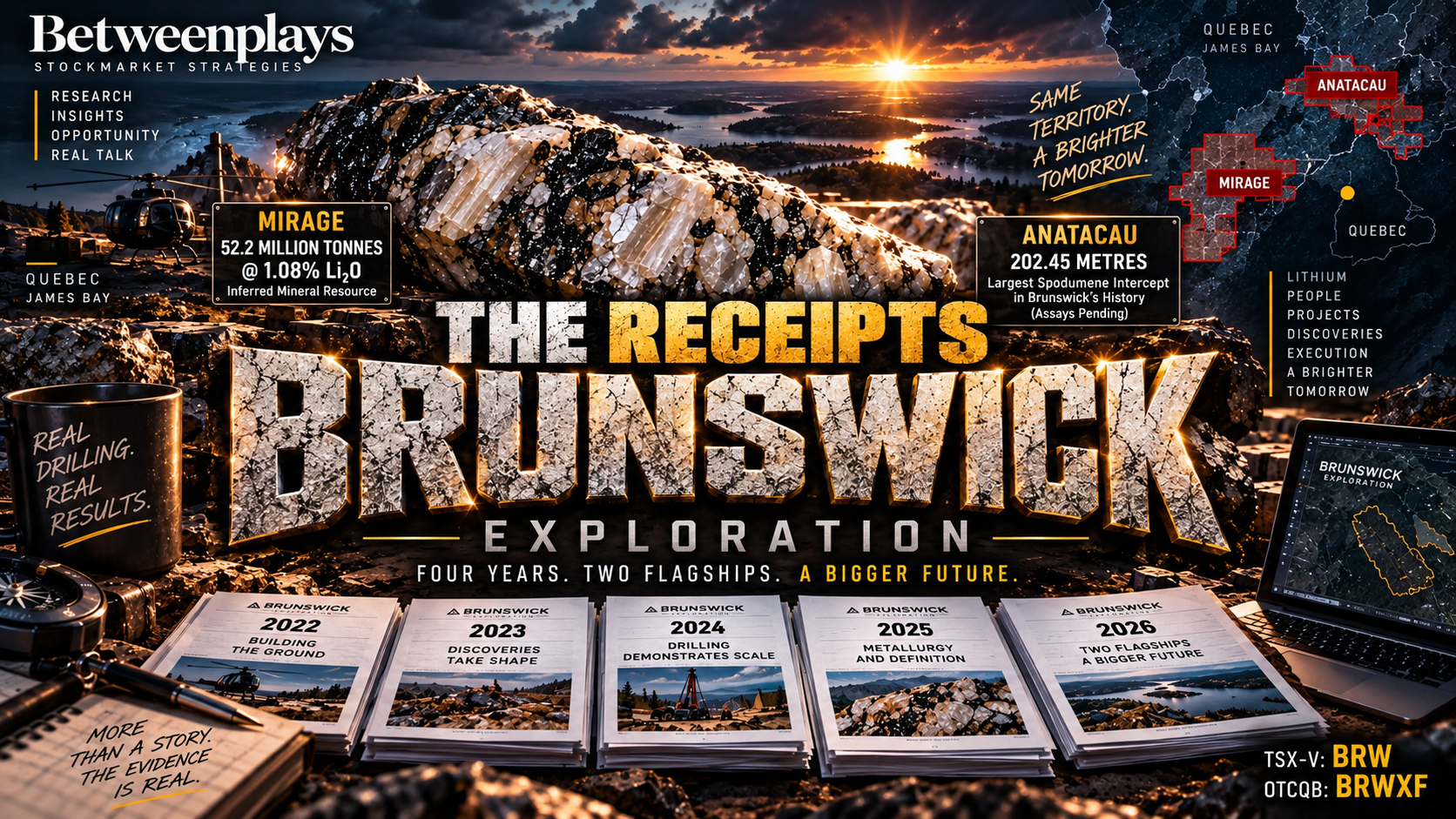

From Grassroots Exploration to Two Flagship Lithium Discoveries — The Documented 2022–2026 Timeline
By Albert Laurin | Betweenplays Media
There are opinions.
There are projections.
There are investment theses.
And then there are the receipts.
Betweenplays has followed Brunswick Exploration Inc. (TSX-V: BRW; OTCQB: BRWXF) since Q1-2022, through property acquisitions, financings, grassroots prospecting, forest fires, discoveries, drilling campaigns, metallurgical testing and, ultimately, the establishment of a maiden mineral resource at Mirage.
This article is different from our My “All In” Stock series.
This isn’t about looking back at what we believed Brunswick could become.
This is about documenting what Brunswick actually did.
Date by date.
Discovery by discovery.
Drill hole by drill hole.
And directly back to the original company disclosures wherever possible.
No hindsight reconstruction.
No rewriting history.
These are the receipts.
2022 — Building the Ground
Before Mirage was a discovery, before Anatacau produced major drill results and before Brunswick had a lithium mineral resource, management was assembling an enormous grassroots exploration portfolio.
June 6, 2022 — The Grassroots Lithium Strategy Begins
Brunswick announced the start of what it called the largest grassroots lithium exploration program in Eastern Canada.
Prospecting teams were deployed across Quebec and Atlantic Canada, targeting spodumene-bearing pegmatites and other prospective lithium environments.
This is an important starting point because the strategy that would eventually produce Mirage was already visible: Brunswick intended to systematically search large, underexplored areas for previously unrecognized lithium-bearing pegmatites.
June 14, 2022 — A Major James Bay Position
Eight days later, Brunswick announced the acquisition of a major position in Quebec’s James Bay region.
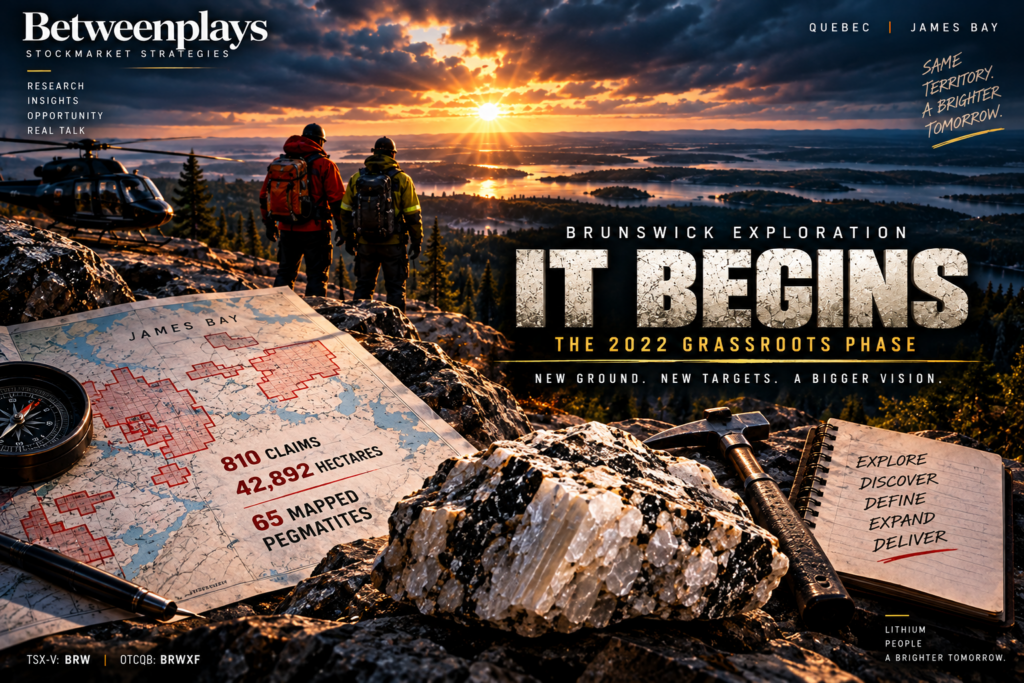
Approximately 810 claims across 22 blocks covering 42,892 hectares were staked.
Brunswick reported approximately 65 large mapped pegmatite dykes, with strike lengths ranging from roughly 900 metres to 7 kilometres.
This was grassroots exploration at scale.
THE RECEIPT:
Brunswick Exploration — Expands Lithium Portfolio in Quebec With New Properties in James Bay — June 14, 2022
July 12, 2022 — Exploration Capital
Brunswick closed non-brokered private placements for gross proceeds of approximately:
$1.01 million.
The company stated that proceeds were expected to be used for property exploration and general corporate purposes.
For a junior company attempting a large grassroots exploration campaign, access to exploration capital matters.
THE RECEIPT:
Brunswick Exploration — Closing of Non-Brokered Private Placement — July 12, 2022
October 3, 2022 — Hearst, Ontario
Brunswick expanded its lithium portfolio into Ontario through staking and option agreements around the Hearst Project.
The package included the spodumene-bearing Decoy pegmatite and a much broader prospective land position.
It was another example of the company’s strategy at the time: build a large pipeline of grassroots lithium targets and systematically test them.
October 4, 2022 — Another $1.15 Million
Brunswick announced that it had received approximately:
$1.15 million
through warrant exercises.
Again, exploration requires capital.
The company was continuing to fund an increasingly ambitious lithium strategy.
November 10, 2022 — Ground Beside Corvette
Brunswick signed an option agreement with Midland Exploration covering the Mythril and Elrond properties.
The Mythril property was located immediately north of Patriot Battery Metals’ Corvette project.
This further strengthened Brunswick’s position within the emerging James Bay lithium district.
THE RECEIPT:
Brunswick Exploration — Property Immediately Adjacent to PMET’s Corvette Discovery — November 10, 2022
November 28, 2022 — Anatacau Enters the Story
Brunswick announced an option covering ground interpreted as a potential extension of the lithium-bearing geological environment associated with the neighbouring James Bay lithium system.
This became:
Anatacau West.
At the time, nobody knew how important the name Anatacau would eventually become to Brunswick.
December 5, 2022 — PLEX
Brunswick expanded again, obtaining an option to acquire a 90% interest in the PLEX Project.
PLEX lies along the La Grande structural corridor associated with Patriot Battery Metals’ Corvette lithium trend.
By the end of 2022, Brunswick wasn’t simply holding isolated lithium prospects.
It was building a regional exploration strategy.
THE RECEIPT:
Brunswick Exploration — PLEX Project Option — December 5, 2022
2023 — The Strategy Meets the Rocks
January 4, 2023 — Killian Charles Becomes President and CEO
Brunswick reviewed its inaugural 2022 lithium exploration campaign and prepared for a much larger 2023 program.
Management also changed.
Killian Charles became:
President and CEO.
Brunswick said the previous year’s work had helped refine its exploration model and identify high-priority targets.
The company was preparing to drill.
THE RECEIPT:
Brunswick Exploration — 2022 Lithium Exploration Review and Corporate Update

January 24, 2023 — Mirage Enters the Portfolio
This date matters.
Brunswick announced that it had staked additional claims and optioned a claim block from Globex Mining Enterprises in James Bay.
Collectively, the property was called:
MIRAGE.
Mirage comprised 198 claims covering approximately 8,884 hectares at the time of the announcement.
And buried inside that original release was the reason Brunswick had become interested in the ground: historical observations of angular pegmatitic glacial boulders containing well-defined spodumene crystals.
There was no mineral resource.
There were no spectacular drill intercepts.
There wasn’t even a confirmed Brunswick discovery yet.
It was a grassroots exploration target.
THE RECEIPT:
Brunswick Exploration Adds the Mirage Project to Its Quebec Lithium Portfolio — January 24, 2023
That date is worth remembering.
Because everything that follows at Mirage came after it.
March 20, 2023 — The Drills Turn at Anatacau West
Brunswick began a 3,000-metre drilling program at Anatacau West.
The program targeted the potential eastern continuation of lithium-bearing geology associated with the neighbouring James Bay lithium system.
The grassroots strategy was now meeting the drill bit.
THE RECEIPT:
Brunswick Exploration Begins Drilling at Anatacau West — March 20, 2023
April 20, 2023 — First Significant Anatacau West Intercepts
The maiden Anatacau West drilling campaign intersected multiple spodumene-bearing pegmatites.
Reported pegmatite intervals reached up to:
32.9 metres.
The grassroots strategy had now produced drill-confirmed spodumene mineralization.
May 24, 2023 — Grade Arrives
Brunswick reported:
26.5 metres grading 1.51% Li₂O.
This was no longer simply visual spodumene.
Assays were putting numbers behind Anatacau West.
June 14, 2023 — Mirage Changes Everything
Almost exactly one year after Brunswick announced its major James Bay staking initiative, the company announced something very different.
At Mirage, field crews identified a major trend of large spodumene-bearing pegmatite boulders extending over approximately:
1.7 kilometres.
More than 20 large spodumene-bearing boulders had been identified.
Brunswick immediately elevated Mirage to a top corporate priority.
But there was an important unanswered question:
Where was the source?
The boulders suggested something significant existed nearby.
The company still had to find it.
THE RECEIPT:
Brunswick Exploration Identifies Major Spodumene-Bearing Pegmatite Boulder Field at Mirage — June 14, 2023
July 13, 2023 — Anatacau Main and Anais
While attention was beginning to turn toward Mirage, Brunswick announced another grassroots discovery.
At Anatacau Main, prospecting identified a significant lithium pegmatite outcrop measuring at least approximately:
100 metres × 15 metres.
The showing became known as:
ANAIS.
Remember that name.
Three years later, Anais would produce the largest single pegmatitic drill intercept Brunswick had ever reported.
THE RECEIPT:
Brunswick Exploration Finds New Large Spodumene-Bearing Pegmatite at Anatacau Main — July 13, 2023
July 26, 2023 — Back to Mirage
Following improvement in the James Bay forest-fire situation, Brunswick restarted exploration at Mirage.
The objective was straightforward:
Find the source of the boulders.
Brunswick was also preparing permitting for drilling.
THE RECEIPT:
Brunswick Exploration Announces Restart of Exploration at Mirage — July 26, 2023
August 21, 2023 — The Source Begins Revealing Itself
The Mirage boulder train had expanded to approximately:
3 kilometres.
More importantly, Brunswick identified several spodumene-bearing pegmatite outcrops extending along an additional approximately 2.7-kilometre trend.
Together, the boulder and outcrop trend covered more than:
5.5 kilometres.
Mirage was rapidly moving from a boulder discovery toward a substantial bedrock exploration target.
THE RECEIPT:
Brunswick Exploration — Mirage Project Update — August 21, 2023
August 28, 2023 — Brunswick Refocuses on James Bay
Brunswick made a consequential strategic decision.
Exploration activities in Ontario, Manitoba and Saskatchewan were paused.
Resources would be redirected toward James Bay.
Mirage had changed the company’s priorities.
THE RECEIPT:
Brunswick Exploration — Ontario, Manitoba and Saskatchewan Update — August 28, 2023
September 7, 2023 — Brunswick Drills Mirage
The speculation was about to meet the drill bit.
Brunswick launched a minimum:
5,000-metre drill program.
The initial 26-hole program targeted six of the widest spodumene-bearing pegmatite dykes identified at Mirage.
Further prospecting had now extended the mineralized dyke trend to approximately:
6 kilometres.
The question was no longer whether spodumene existed at Mirage.
The question was what existed beneath the surface.
THE RECEIPT:
Brunswick Exploration Launches 5,000-Metre Drill Program at Mirage — September 7, 2023
October 3, 2023 — Another Grassroots Discovery: Elrond
Brunswick announced a previously undocumented spodumene-bearing pegmatite at Elrond.
The Arwen showing demonstrated that Brunswick’s grassroots methodology was producing discoveries beyond Mirage and Anatacau.
At Mirage, meanwhile, drilling was underway.
THE RECEIPT:
Brunswick Exploration Announces Spodumene-Bearing Pegmatite Discovery at Elrond — October 3, 2023
December 4, 2023 — Mirage Drilling Delivers
Brunswick released the inaugural assays from Mirage.
Among the results:
25.8 metres grading 2.57% Li₂O
including:
14.2 metres grading 3.08% Li₂O.
Another hole returned:
50.6 metres grading 1.06% Li₂O.
The pegmatites drilled to that point began at surface and remained open.
Mirage was no longer a prospecting story.
It was a drill-confirmed lithium discovery.
THE RECEIPT:
Brunswick Exploration Intersects Significant Spodumene Mineralization at Mirage — December 4, 2023
December 19, 2023 — MR-4 Reaches 600 Metres
Additional Mirage assays included:
10.6 metres grading 3.28% Li₂O
and:
14.0 metres grading 2.92% Li₂O.
MR-4 had been traced by drilling across approximately:
600 metres of strike.
And it remained open.
THE RECEIPT:
Brunswick Exploration Extends MR-4 High-Grade Mineralization to 600 Metres — December 19, 2023
2024 — Demonstrating Scale
January 22, 2024 — Phase II Begins
Brunswick returned to Mirage with its Phase II winter drilling campaign.
The objective was no longer simply discovery.
It was expansion.
Management explicitly stated its intention to rapidly demonstrate the potential to build tonnage at Mirage.
THE RECEIPT:
Brunswick Exploration Starts Winter Drilling Campaign at Mirage — January 22, 2024
April 25, 2024 — 58.1 Metres From Surface
Brunswick reported:
58.1 metres grading 1.59% Li₂O
starting from surface at Mirage.
The scale question was becoming increasingly important.
May 8, 2024 — 93.45 Metres
Then came one of Mirage’s defining holes.
MR-24-62 returned:
93.45 metres grading 1.55% Li₂O.
The interval started at surface.
Brunswick described it as its best Mirage interval to that point.
MR-6 remained open.
THE RECEIPT:
Brunswick Exploration Drills 93.45 Metres at 1.55% Li₂O at MR-6 — May 8, 2024
June 4, 2024 — MR-6 Continues
Additional drilling returned:
69.3 metres grading 1.64% Li₂O.
The picture emerging from Mirage was increasingly one of multiple significant lithium-bearing dykes rather than a single isolated structure.
THE RECEIPT:
Brunswick Exploration Drills 69.3 Metres at 1.64% Li₂O at MR-6 — June 4, 2024
July 23, 2024 — Mirage Keeps Expanding
Brunswick reported new spodumene-rich boulder trains and launched another:
5,000-metre summer drilling program.
By then, 71 drill holes totalling more than 12,000 metres had delineated nine near-surface spodumene-bearing pegmatite dykes.
All nine remained open along strike and at depth.
THE RECEIPT:
Brunswick Exploration — New Mirage Boulder Trains and Summer Drill Campaign — July 23, 2024
2025 — Discovery Moves Toward Definition
Finding lithium is one thing.
Demonstrating potential processing characteristics is another.
Ultimately defining tonnes is another again.
January 20, 2025 — Another 5,000 Metres
Brunswick launched another minimum 5,000-metre winter drill campaign at Mirage.
The program targeted undrilled areas as well as potential extensions of MR-3, MR-6 and the stacked-dyke system.
THE RECEIPT:
Brunswick Exploration Starts 2025 Winter Drilling Campaign at Mirage — January 20, 2025
February 3, 2025 — Metallurgy
Brunswick reported preliminary Phase 1 metallurgical results from Mirage.
Heavy-liquid separation testing produced approximately:
76% recovery into a 5.5% Li₂O concentrate.
DMS testing produced approximately:
68.4% recovery into a 5.7% Li₂O concentrate.
Brunswick said the preliminary results demonstrated the potential for a crushing-and-DMS flowsheet without flotation.
These were preliminary metallurgical results and further work remained necessary.
But the Mirage story now included more than drill widths and grades.
It included preliminary processing characteristics.
THE RECEIPT:
Brunswick Exploration Reports Phase 1 Metallurgical Results at Mirage — February 3, 2025
July 9, 2025 — Four New Major Dykes
Results from the 2025 winter campaign brought the number of newly identified major dykes that year to four.
Results included:
33.2 metres grading 1.1% Li₂O
and:
20 metres grading 1.3% Li₂O.
The company was also updating its 3D geological model in preparation for a first mineral resource estimate.
The question investors had been asking since the discovery was approaching an answer:
How many tonnes are actually there?
THE RECEIPT:
Brunswick Exploration Has Now Identified Four Major New Dykes at Mirage — July 9, 2025
2026 — Tonnes, Anatacau and a Second Flagship
January 8, 2026 — Mirage Gets Its Number
Brunswick announced its maiden open-pit Inferred Mineral Resource Estimate for Mirage:
52.2 MILLION TONNES
grading:
1.08% Li₂O
and 131 ppm Ta₂O₅.
At a 0.5% Li₂O-equivalent cut-off, Brunswick reported total contained lithia exceeding:
550,000 tonnes.
More than 70% of the resource was contained within five dykes situated above approximately 150 metres vertical depth.
For the first time, Mirage wasn’t simply discussed in terms of individual drill holes.
It had an NI 43-101-compliant:
Inferred Mineral Resource.
Brunswick also identified a separate conceptual Exploration Target of:
40–50 million tonnes
grading approximately:
0.80–1.10% Li₂O.
That distinction is critical.
The 40–50 Mt Exploration Target is not a mineral resource. Its potential quantity and grade are conceptual, and there has been insufficient exploration to define it as a mineral resource.
April 15, 2026 — Anatacau Accelerates
Initial results from Brunswick’s 2026 winter drilling at Anatacau Main included:
90.5 metres grading 1.31% Li₂O
within a larger package of:
167.9 metres grading 1.02% Li₂O.
A newly discovered dyke below Anais Main returned:
6.8 metres grading 1.52% Li₂O.
Anais Main had now been defined to approximately 190 metres vertical depth and remained open.
THE RECEIPT:
Brunswick Exploration Drills 90.5 Metres at 1.31% Li₂O at Anatacau — April 15, 2026
April 30, 2026 — Brunswick Exercises the Anatacau Option
Brunswick completed the required expenditures and share payments under its Anatacau option agreement.
The result:
Brunswick acquired a 90% interest in Anatacau Main and Anatacau West.
The company retained a right of first refusal over the remaining free-carried 10% interest.
The property Brunswick had optioned years earlier was becoming one of its most important assets.
THE RECEIPT:
Brunswick Exploration Completes Option Agreement for Anatacau Main and West — April 30, 2026
May 11, 2026 — The Anatacau Corridor Expands
AN-26-08 returned:
123 metres grading 0.72% Li₂O
including:
17.7 metres grading 1.10% Li₂O.
The mineralized pegmatite zone within the structural corridor containing Anais had now been extended more than:
500 metres eastward.
And remained open.
THE RECEIPT:
Brunswick Exploration Drills 17.7 Metres at 1.10% Li₂O Within 123 Metres at 0.72% Li₂O — May 11, 2026
June 10, 2026 — Anais Beyond 350 Metres
AN-26-12 returned:
27.4 metres grading 1.13% Li₂O.
Brunswick reported that the Anais Main dyke remained open in all directions.
The broader mineralized dyke system had been delineated across an area approximately:
350 metres wide × 600 metres long.
And it remained open.
THE RECEIPT:
Brunswick Exploration Increases Anais Strike Extent to Over 350 Metres — June 10, 2026
July 6, 2026 — Two Flagships
This release marked an important change in Brunswick’s own description of its Quebec portfolio.
Brunswick launched a new drilling program targeting:
MIRAGE + ANATACAU MAIN.
And explicitly described them as its:
two flagship Quebec projects.
Approximately 6,000 metres of drilling were planned across the two assets — approximately 4,000 metres at Mirage and 2,000 metres at Anatacau.
Mirage already had its resource.
Anatacau was now being advanced beside it.
THE RECEIPT:
Brunswick Exploration Launches Summer Drill Program Targeting Mirage and Anatacau — July 6, 2026
September 17, 2026 — 202.45 Metres
Then came AN-26-15.
The hole represented an approximately 130-metre down-dip step-out targeting Anais Main.
It encountered three major pegmatitic intervals:
8.35 metres.
21.50 metres.
And then:
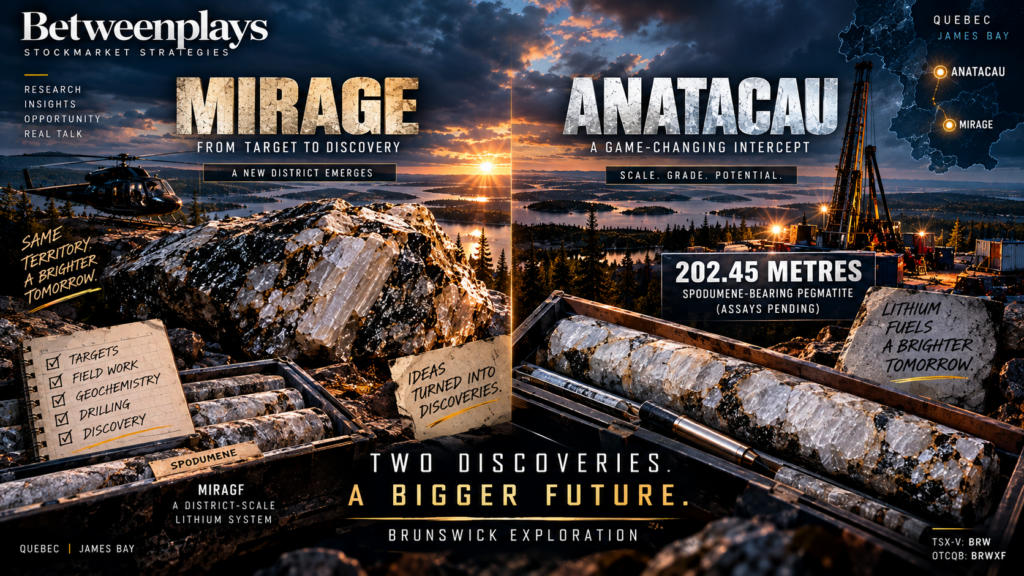
202.45 METRES
of spodumene-bearing pegmatite.
Brunswick visually estimated spodumene content averaging approximately:
25%
across the interval, with localized concentrations reaching approximately:
35%.
At the time of the announcement:
assays were still pending.
That distinction cannot be overstated.
Visual spodumene estimates are not laboratory Li₂O assays.
Likewise, 202.45 metres represents a drill-hole interval and should not automatically be interpreted as 202.45 metres of true geological thickness.
Brunswick estimated the true thickness of the Anais dyke at approximately 75% of the reported interval.
What can be stated without qualification is what Brunswick itself reported:
AN-26-15 represented the:
largest single pegmatitic intercept drilled by Brunswick Exploration across its entire portfolio.
The hole extended Anais Main to approximately:
300 metres vertical depth.
The Anais system had been traced over a footprint of approximately 650 × 350 metres.
And it remained:
OPEN IN ALL DIRECTIONS.
Now Step Back and Look at the Record
Individual press releases can make exploration look like a collection of disconnected events.
Put them in chronological order and a very different picture emerges.
2022: Build the portfolio.
January 2023: Acquire Mirage.
March 2023: Begin drilling Anatacau.
June 2023: Find the Mirage boulder field.
August 2023: Find the bedrock source.
September 2023: Drill it.
December 2023: Confirm significant lithium mineralization.
2024: Demonstrate width, grade and scale.
2025: Continue expansion and establish preliminary processing characteristics.
January 2026: Define a 52.2 Mt Inferred Mineral Resource at Mirage.
Spring 2026: Expand Anatacau.
July 2026: Mirage and Anatacau become Brunswick’s two flagship Quebec projects.
September 2026: Drill a 202.45-metre interval of spodumene-bearing pegmatite at Anais Main.
That’s how Brunswick moved from a grassroots lithium exploration strategy to a defined resource at Mirage and a rapidly expanding discovery at Anatacau.
But here’s the most important part:
The timeline isn’t finished.
AN-26-15 assays remain outstanding as of this article’s publication.
Anatacau remains open.
Mirage remains open to further exploration.
Drilling continues to generate new information.
The record will change.
And when it does:
We’ll add another receipt.

This Isn’t the Flavor of the Day
Now step back from Brunswick for a moment and look at the junior exploration sector itself.
How many companies have had four years to execute?
How many have raised money, issued shares, paid management, promoted their story and repeatedly told investors that the next exploration program could be the one?
And after all that time, what do they actually have to show for it?
Where are the drill cores?
Where are the assays?
Where are the discoveries?
Where are the tonnes?
Those are questions every investor in the junior exploration market should be asking.
Because hope is not an exploration result.
A press release is not a discovery.
Raising enough capital to keep the lights on is not the same thing as creating value with that capital.
And eventually, investors have to ask themselves a difficult question:
Am I still financing an opportunity—or am I financing a story that isn’t going anywhere?
Now compare that question with the timeline you’ve just read.
This isn’t a lifestyle company.
This isn’t a flavor-of-the-day company jumping from one market narrative to another.
When Betweenplays began following Brunswick Exploration in 2022, Killian Charles and his team laid out a grassroots lithium exploration strategy.
Acquire prospective ground.
Build targets.
Put geologists in the field.
Drill.
Discover.
And then keep drilling to determine what is actually there.
Go back through the receipts.
They raised capital.
They acquired the ground.
They deployed the exploration teams.
They generated targets.
They drilled Anatacau.
They discovered Mirage.
They drilled Mirage.
They produced assays.
They expanded the discovery.
They conducted metallurgical testing.
And in January 2026, Mirage became a 52.2-million-tonne Inferred Mineral Resource grading 1.08% Li₂O.
Then Brunswick went back to Anatacau.
Today, Anatacau Main is one of the company’s two flagship Quebec projects, and AN-26-15 has delivered the largest single pegmatitic drill intercept Brunswick has ever reported across its portfolio:
202.45 metres of spodumene-bearing pegmatite.
The assays are still pending.
There is still an enormous amount to prove.
But that is precisely the point.
Brunswick isn’t asking investors to believe the same story it was telling four years ago without evidence.
The evidence has been accumulating.
That is execution.
Isn’t That What Investing Is About?
Every investor ultimately has to make that decision for themselves.
For me, investing is about allocating capital toward the opportunities where I believe the combination of management, assets, execution, industry fundamentals and potential return gives me the strongest opportunity.
That doesn’t mean every investment works.
It doesn’t mean Brunswick is guaranteed to succeed.
And it certainly doesn’t mean investors should ignore risk.
It means capital has an opportunity cost.
If you own a company that has repeatedly failed to execute, there is nothing that says your capital has to remain there forever simply because you already own it.
Sometimes preserving what capital remains and redeploying it toward an opportunity you believe has demonstrated stronger execution is itself an investment decision.
So compare.
Look at other lithium explorers.
Look at their resources.
Look at their grades.
Look at their jurisdictions.
Look at their metallurgy.
Look at their infrastructure.
Look at their market capitalizations.
Look at what management said it would accomplish.
Then look at what management actually accomplished.
And make your own decision.
Then Look at Lithium Itself
My conviction in Brunswick doesn’t exist independently of my conviction in lithium.
Look beyond today’s lithium spot price and consider where batteries are being deployed.
Electric vehicles.
Commercial transportation.
Grid-scale energy storage.
Renewable-energy storage.
Data centres.
AI infrastructure.
Industrial automation.
Robotics.
Consumer electronics.
And applications that haven’t even reached commercial scale yet.
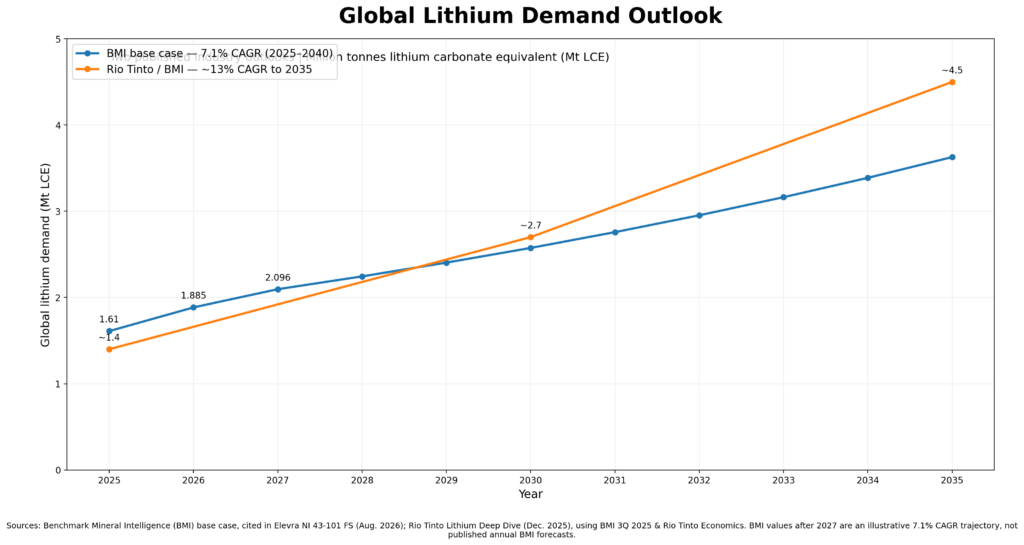
The International Energy Agency projects lithium demand to more than triple by 2040 under its Stated Policies Scenario—the strongest demand growth among the critical minerals it tracks.
EV battery demand alone is expected to exceed 3 TWh by 2030, more than three times its 2024 level.
And stationary battery storage represents another enormous potential source of demand.
This isn’t simply about how many electric cars are sold next year.
It’s about the electrification of an increasingly battery-dependent economy.
And Then Comes the Next Generation of Batteries
Now consider what could happen as battery technology itself improves.
Solid-state batteries are being developed with the potential for greater energy density, improved safety and other performance advantages compared with today’s conventional lithium-ion batteries.
If manufacturers eventually commercialize solid-state batteries at scale, the implications for electric transportation could be significant.
Longer practical driving ranges.
Potentially faster charging.
Better overall battery performance.
Improved safety characteristics.
And potentially better performance across a wider range of operating conditions.
Think about what those improvements attack.
Range anxiety.
Charging inconvenience.
Battery weight.
Safety concerns.
Cold-weather performance.
These are among the barriers that have influenced consumer adoption of electric vehicles.
If the industry succeeds in materially reducing those barriers, what happens to EV adoption?
What happens to battery demand?
What happens to stationary storage as electricity demand grows alongside AI, data centres and the broader electrification of the economy?
And ultimately:
What happens to lithium demand?
I don’t pretend to know exactly how that future unfolds.
Nobody does.
Competing battery chemistries will evolve.
Recycling will grow.
Sodium-ion and other technologies will compete for certain applications.
Commodity markets will cycle.
Lithium prices will rise and fall.
But when I look at the direction of electrification, battery storage and transportation:
My bet remains on lithium.
And when I look across the lithium exploration space, my job isn’t to find a company that can tell the best story.
It’s to find one that can execute.
For me, Brunswick Exploration has been doing exactly that.
That’s why it became:
My “All In” Stock.
Not because the story was already written.
Not because the outcome is guaranteed.
But because management told us what it intended to do—and then went into the field and started doing it.
The receipts are now sitting in front of us.
And the most interesting part?
The story hasn’t ended.
Mirage is still being explored.
Anatacau is still being drilled.
AN-26-15 assays are still to come.
There are still questions to answer.
There are still metres to drill.
And there are still chapters to write.
Look out for My “All In” Stock — Part IV, coming soon from Betweenplays.
Because after more than three years of following this story from the grassroots…
It’s finally time for Part IV.

Verify It Yourself
That’s ultimately what The Receipts is about.
Not telling investors what to believe.
Not asking readers to rely on our interpretation.
Giving them the original record and allowing them to investigate it themselves.
Brunswick Exploration — Complete News Release Archive
Brunswick has also filed its maiden NI 43-101 Mineral Resource Estimate technical report supporting the Mirage resource.
Brunswick Exploration — Mirage Maiden Mineral Resource NI 43-101 Technical Report Announcement
Read the releases.
Check the dates.
Check the numbers.
Follow the drilling.
Do your own research.
Those are the receipts.
Disclosure
Albert Laurin, founder of Betweenplays StockMarket Strategies Inc. and author of this article, is a shareholder of Brunswick Exploration Inc. (TSX-V: BRW).
Betweenplays Media has followed Brunswick Exploration since Q1 of 2022 and has interviewed President and CEO Killian Charles on multiple occasions.
This article represents historical research, commentary and analysis by Betweenplays Media and is provided for informational purposes only. It does not constitute investment advice or a recommendation to purchase or sell securities.
Mineral exploration and development involve substantial risks. Exploration Targets are conceptual in nature and are not mineral resources. Visual estimates of spodumene are not substitutes for laboratory assays. Drill-hole intervals do not necessarily represent true geological thickness. Historical exploration results and individual drill intercepts should not be interpreted as demonstrating economic viability.
Statements regarding future lithium demand, battery technologies and potential market development are forward-looking and subject to substantial technological, economic and market uncertainty.
Readers should conduct their own due diligence and review Brunswick Exploration’s complete news releases, technical reports and regulatory filings before making investment decisions.
Betweenplays Media
Research. Context. The Story Behind the Market.
