


Why Attack Paths Will Define the Next Era of Cyber Defence
For years, cybersecurity teams have focused on identifying and patching individual vulnerabilities. Vulnerability scanners produce lists of findings, each assigned a severity score, and security teams work through them according to available resources and maintenance windows.
That approach may no longer be sufficient. The emergence of highly capable cybersecurity-focused AI systems, such as Anthropic’s Claude Mythos, suggests that the next major challenge in cybersecurity may not be finding individual vulnerabilities. It may be discovering how multiple seemingly harmless weaknesses can be combined into devastating attack paths.
The implications are significant, particularly for organizations that lack a dedicated Security Operations Center (SOC) or large cybersecurity teams.

The Traditional Model: One Vulnerability at a Time
For decades, vulnerability management has largely treated security flaws as independent risks. A security scan might reveal:
- An information disclosure vulnerability rated Low.
- A configuration issue rated Low.
- An authentication weakness rated Medium.
- A privilege management issue rated Medium.
Each issue is evaluated separately.
The assumption is that a Low-severity vulnerability poses limited risk and can often wait until the next patch cycle. Quarterly patching schedules were once common. Many organizations later moved to monthly patching, supplemented by emergency updates for especially critical vulnerabilities.
This approach worked reasonably well when discovering and exploiting vulnerabilities required substantial human expertise and effort. A skilled attacker might spend days or weeks investigating a target environment, manually connecting disparate pieces of information to identify a viable attack path. The bottleneck was human labor, but AI will remove that bottleneck.
The Real Threat: Vulnerability Chaining at Scale
Security professionals have long understood that major breaches rarely result from a single vulnerability.
Instead, attackers often chain multiple weaknesses together. Consider a hypothetical example:
- A low-severity information disclosure reveals internal hostnames.
- A low-severity configuration error exposes service account details.
- A medium-severity application vulnerability allows code execution under that service account.
- An overlooked Active Directory permission enables privilege escalation.
Individually, none of these findings might trigger alarm. Together, they could provide an attacker with complete control over an organization’s environment.

Historically, identifying these attack chains required experienced penetration testers, red teams, or advanced threat actors.
AI changes the equation. A sufficiently capable model can analyze source code, network architecture, cloud configurations, documentation, vulnerability reports, identity systems, and security controls simultaneously. Instead of examining one possible attack path, it can explore thousands. What previously took a human analyst days or weeks could potentially be accomplished in minutes or hours.
The Shrinking Window Between Discovery and Exploitation
The cybersecurity industry is already seeing signs of accelerated timelines. When a major vulnerability is publicly disclosed today, proof-of-concept exploit code often appears within hours. Threat actors rapidly begin scanning the internet for exposed systems. The time between vulnerability disclosure and active exploitation has steadily decreased over the past decade. AI is likely to accelerate this trend further.
Traditionally, the lifecycle looked something like this:
- Vulnerability discovered.
- Researcher analyzes the flaw.
- Exploit developed.
- Exploit tested.
- Attackers weaponize the exploit.
- Organizations patch the vulnerability.
This process could take weeks or even months. With AI-assisted vulnerability research, the timeline could compress dramatically:
- Vulnerability discovered.
- AI analyzes the flaw.
- AI generates exploit candidates.
- Researchers validate the results.
- Exploitation begins.

In some cases, the entire process could occur within a single day. The concern is not necessarily that AI will instantly generate flawless exploits for every vulnerability. Real-world attacks still require adaptation, testing, and operational expertise. The concern is that AI can eliminate much of the research phase that previously slowed attackers down. As a result, organizations may find themselves facing active exploitation far sooner than they did in the past.
Why Quarterly Patching Is Becoming Obsolete
This trend challenges traditional patch management practices. Quarterly patch cycles made sense when organizations had significant time between vulnerability disclosure and exploitation. That assumption no longer holds.
Yet daily patching is not realistic for most organizations. Businesses operate complex environments that include:
- Legacy applications
- Manufacturing systems
- Healthcare systems
- Mission-critical infrastructure
- Strict change management processes
Constant patching can introduce operational risk equal to or greater than the vulnerability itself. The future is therefore unlikely to be daily patching of everything. Instead, organizations will move toward continuous risk-based remediation. In this model:
- Critical internet-facing vulnerabilities may be addressed within hours.
- High-risk internal vulnerabilities may be remediated within days.
- Lower-priority issues may continue to follow monthly patch cycles.
The key change is that organizations will increasingly prioritize vulnerabilities based on exploitability and attack-path potential rather than simply relying on severity scores.
Security Fundamentals Become More Important
One surprising aspect of the AI revolution is that it may actually increase the importance of traditional security controls. Many people assume that advanced AI requires entirely new defensive technologies. In reality, AI often magnifies existing weaknesses. Organizations with poor security hygiene are likely to suffer the most.
Critical controls remain largely unchanged:
- Multi-factor authentication
- Privileged access management
- Endpoint detection and response
- Network segmentation
- Identity governance
- Vulnerability management
- Security monitoring
The difference is that attackers may be able to identify weaknesses in these controls much more quickly.
An AI-powered adversary does not necessarily need a sophisticated zero-day vulnerability if it can rapidly discover a chain of ordinary weaknesses that leads to the same outcome.
In this environment, security fundamentals become the first line of defense against AI-accelerated attacks.
The Rise of Exposure Management
This is where exposure management enters the picture.
- Traditional vulnerability management asks: What vulnerabilities exist?
- Exposure management asks: Which vulnerabilities actually matter?
Rather than focusing on individual findings, exposure management focuses on attack paths. For example, an organization might have:
- 2,000 identified vulnerabilities
- 500 misconfigurations
- 100 privileged accounts
- Multiple cloud resources
- Numerous identity relationships
The challenge is not identifying these issues. The challenge is understanding which combinations create exploitable pathways. Exposure management platforms attempt to answer questions such as:
- Which systems are internet-facing?
- Which vulnerabilities are actively exploitable?
- Which users have excessive privileges?
- Which attack paths lead to critical assets?
- Which exposures create ransomware risk?
This approach becomes dramatically more valuable as AI improves attackers’ ability to discover attack chains.
Why Managed Exposure Defense May Become Mainstream
Large enterprises can build internal teams to perform exposure analysis. Most small and medium-sized businesses cannot. They often lack:
- Dedicated security analysts
- Threat hunters
- Vulnerability specialists
- SOC personnel
- Red team capabilities
At the same time, they face many of the same threats as larger organizations.
This creates an opportunity for Managed Exposure Defense services. Such services effectively act as outsourced exposure management teams. Rather than simply producing vulnerability reports, they continuously monitor an organization’s environment and identify the attack paths that present the greatest risk.
The value proposition is simple: Instead of telling customers they have 2,000 vulnerabilities, tell them “Here are the three attack paths most likely to result in a breach this week.”
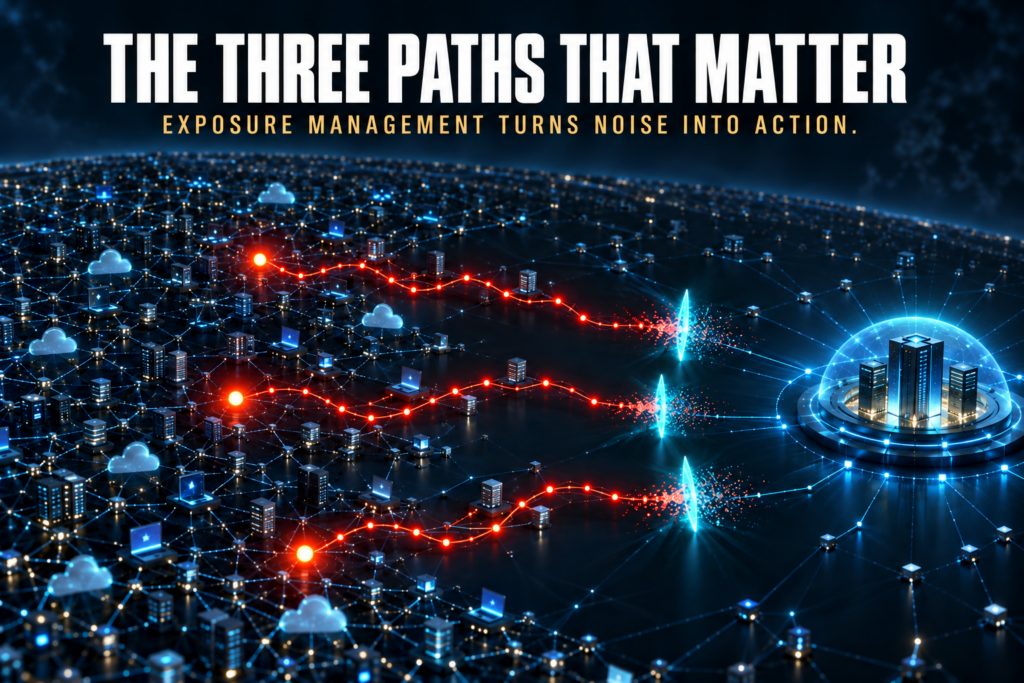
This transforms vulnerability management from a data problem into an operational problem that organizations can realistically address.
The Evolution of Managed Security Services
The cybersecurity industry has followed a similar pattern before. Years ago, many organizations managed antivirus internally. Over time, endpoint protection evolved into managed detection and response (MDR) services. Today, businesses commonly subscribe to:
- Managed endpoint security
- Managed firewalls
- Email security services
- Backup and disaster recovery services
Exposure management appears poised to follow a similar trajectory. In the coming years, organizations may routinely subscribe to:
- Managed Exposure Defense
- Attack path monitoring
- Continuous exposure validation
- AI-assisted remediation services
These offerings will likely become standard components of cybersecurity programs, particularly for organizations without internal security teams.
Beyond Reporting: The Importance of Remediation
One lesson from previous generations of security products is that dashboards alone are not enough. Organizations are already overwhelmed by alerts, reports, and findings. The most successful exposure management solutions will likely focus on remediation rather than reporting. Customers increasingly want services that can:
- Identify exposures
- Prioritize risks
- Recommend fixes
- Automate remediation where possible
- Verify that risks have been eliminated
In other words, organizations want outcomes rather than data.
The future winner in this market may not be the platform that discovers the most vulnerabilities. It will be the platform that eliminates the most risk.
At The End of The Day
AI-powered cybersecurity systems are changing the economics of attack. The greatest risk may not be the discovery of entirely new vulnerabilities. It may be the ability to rapidly identify and exploit complex attack chains composed of multiple low- and medium-severity weaknesses.
As AI reduces the time required for vulnerability discovery, exploit development, and attack-path analysis, organizations will face increasing pressure to respond more quickly.
Quarterly patching cycles are giving way to continuous risk-based remediation. Security teams must prioritize attack paths rather than individual findings. Traditional security controls remain essential, but they must be supported by better visibility into how exposures interact across the environment.
For large enterprises, this challenge may be addressed through dedicated security teams and advanced exposure management platforms. For everyone else, Managed Exposure Defense is likely to emerge as the practical solution.
Just as endpoint security subscriptions became a standard cost of doing business, exposure management services may soon become an expected layer of cyber defense.
In a world where AI can help attackers connect the dots faster than ever before, organizations will need services that can do the same for defenders. The future of cybersecurity may depend less on knowing which vulnerabilities exist and more on understanding which combinations of vulnerabilities create the next breach.
