
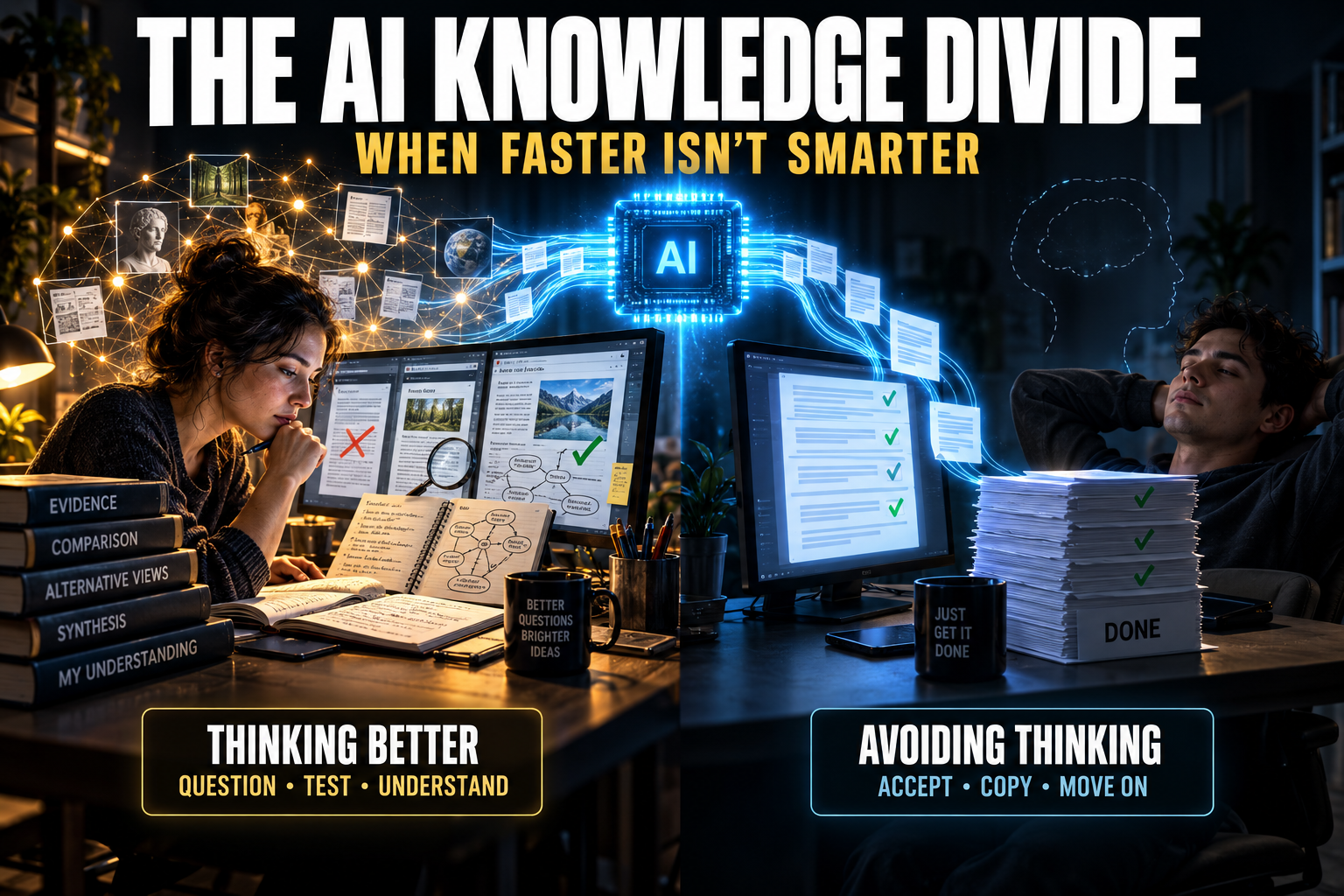

There’s a quiet split happening in how people use AI. It doesn’t show up in the tools they choose or the prompts they write. It shows up in what happens after the answer appears. Do we absorb it into our own understanding, or simply use it and move on? Some people get sharper. Others just get faster. But why?
On the surface, both groups look equally productive. They’re producing polished work, solving problems quickly, and moving through tasks with less friction than ever before. For managers, educators, and clients, the signal looks the same. The output is clean. The deadlines are met. The quality appears high.
But under that surface, something very different is happening. One group is building capability. The other is outsourcing it. These aren’t fixed categories of people. They’re modes of use, and most of us move between them. The divide emerges when one of those modes becomes habitual.
AI hasn’t just changed how we work. It’s exposing why we work the way we do.
The Path of Least Resistance
Human beings naturally gravitate toward paths of lower resistance, particularly when time, uncertainty, and cognitive effort are involved. That bias exists for good reasons. Conserving energy, minimizing risk, and resolving uncertainty quickly are all adaptive behaviours. But in modern cognitive work, they create a predictable pattern: when given the opportunity to reduce effort without immediate consequences, many people will take it.
AI plugs directly into that pattern. Give someone a task they don’t fully understand. Add a deadline. Then give them a tool that can produce a coherent, well-structured answer in seconds. The friction disappears. The discomfort disappears. The task gets done, but so does the learning.
Durable learning depends on cognitive engagement. Certain forms of effort—retrieval, problem solving, explanation, and error correction—are what help knowledge stick. Cognitive scientists sometimes describe these productive forms of effort as “desirable difficulties.”1
This doesn’t mean all difficulty is good. Confusion without direction can simply exhaust someone. It means that certain types of effort, especially those tied to retrieval, problem solving, and correcting mistakes, help build durable knowledge.2
When AI removes those moments, it doesn’t just make work easier. It changes what the learner is required to encode and retrieve.
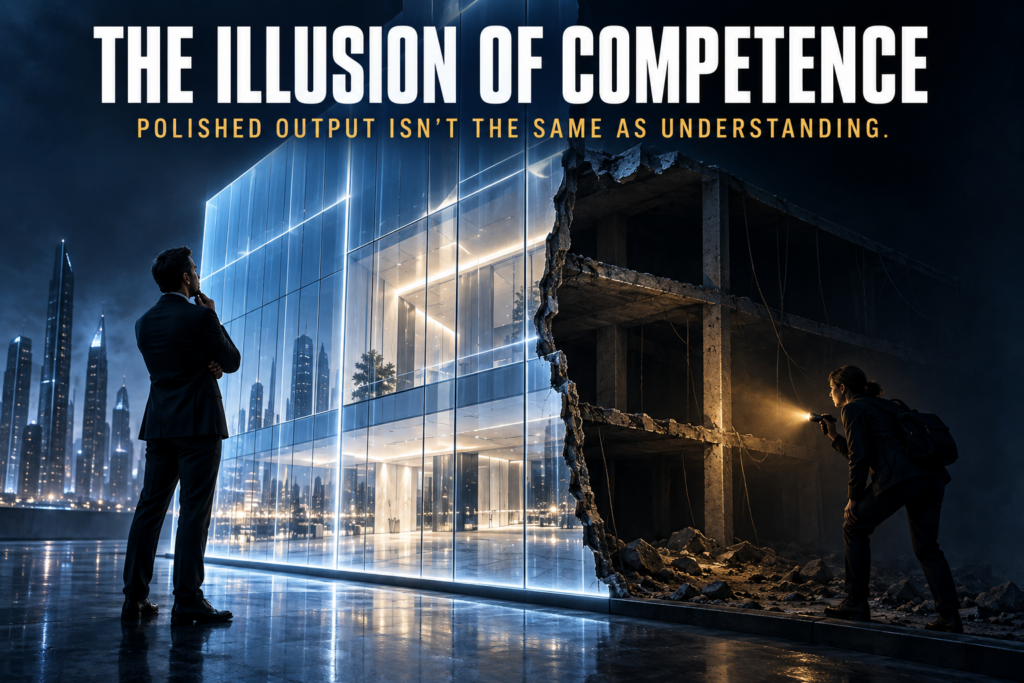
What replaces effort is something more subtle: the illusion of competence. The output looks right. It sounds right. It feels complete. And because it’s easy to follow, it creates the impression of understanding.
But recognition isn’t recollection, and fluency isn’t mastery.
Research has repeatedly shown that people can overestimate what they’ve learned when information feels easy to process.3 This is why rereading notes feels productive but often produces weak retention, while testing yourself feels harder but works better.
Generative AI can amplify that gap. Research involving knowledge workers suggests that greater confidence in AI is associated with less reported critical-thinking effort.4 The result may be a widening separation between perceived understanding and actual capability.
So people move on. The task is complete, but the understanding isn’t.
The Other Way to Use AI
There’s another group using the same tools in a completely different way. They don’t stop at the answer. They interrogate it.
Why does this work? What assumptions does it rely on? Where could it fail? What would a different approach look like?
They compare outputs. They reframe explanations. They try to reproduce the result without assistance. When they fail, they go back and push deeper.
For them, AI isn’t a shortcut. It’s a pressure test.
This approach may be slower in the moment. It keeps some of the friction in place, but it aligns more closely with what builds expertise: deliberate, effortful practice combined with feedback and correction.5
The key difference is not the presence of AI. It’s how the user engages with it. In one mode, AI replaces thinking. In the other, it provokes it.
Over time, the second approach compounds.
These users develop internal models. They understand not just what works, but why it works. They can spot weak reasoning, identify edge cases, and adapt solutions to new contexts.
They don’t just produce output. They understand it well enough to challenge it.
Motivation Is the Real Interface
The difference between these two modes isn’t primarily technical. It’s motivational, although workload, incentives, expertise, and context all influence which mode we choose.
If the goal is to minimize discomfort, AI becomes a way to bypass thinking. If the goal is to build capability, AI becomes a way to stress-test it.
That distinction resembles the difference between performance-oriented and growth-oriented behaviour.6 One prioritizes appearing capable in the moment. The other prioritizes developing capability over time.
AI is uniquely good at satisfying both.
It can eliminate the short-term pain of confusion, uncertainty, and effort. Or it can amplify those same conditions in a controlled way, allowing users to push further and learn faster.
It won’t make the choice for you.

The Cycle No One Talks About
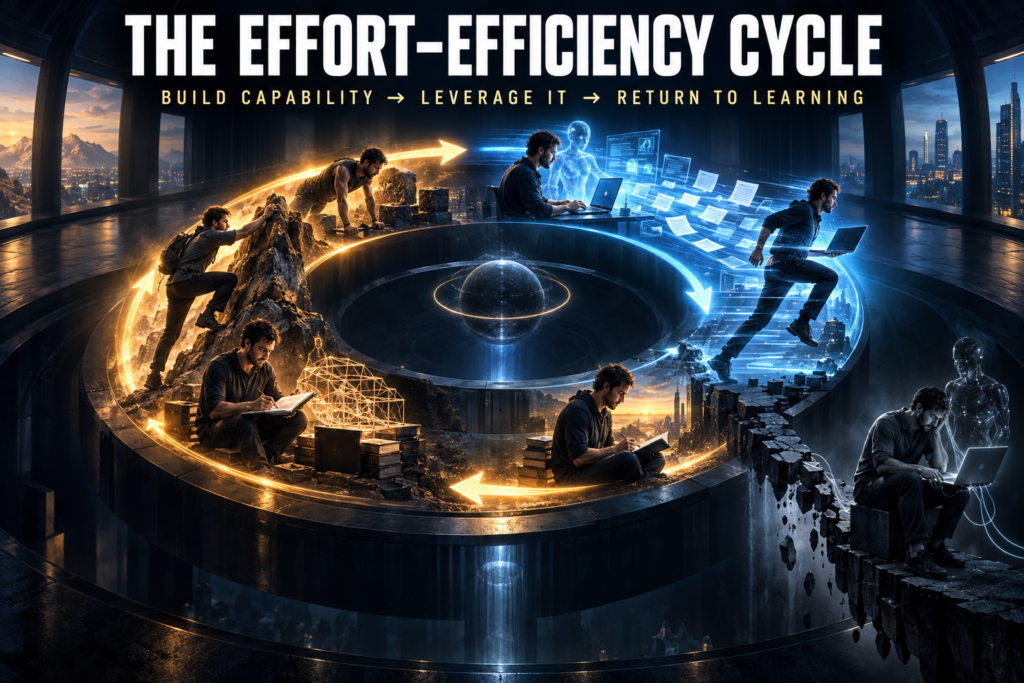
Even people who use AI well don’t stay in that mode all the time. Growth is demanding. Effort has a cost. At some point, most people shift back toward comfort. They use AI to move quickly, clear a backlog, or recover from cognitive fatigue.
That shift isn’t necessarily a failure. It’s part of a cycle.
The problem isn’t using AI for comfort. The problem is staying there.
If someone never returns to a mode where they challenge the output, test their understanding, and rebuild their internal models, their independent capability may begin to weaken—or may simply fail to develop further. They can become dependent on the tool in ways that are difficult to detect until those capabilities are needed.
This is where the real risk lies. Not in using AI, but in gradually losing the ability to function without it.
On the other hand, when people alternate between periods of effort and periods of efficiency, they get the best of both. They build skill. Then they leverage it.
AI doesn’t break this cycle. It accelerates it.
Why Education Is Misaligned
Many educational systems are still measuring the wrong things. They reward correct answers, completed assignments, and speed. All of these can now be achieved with minimal understanding.
What they don’t always measure is whether a student can:
- explain how an answer was produced;
- identify when it’s wrong;
- adapt it to a new context; or
- recognize the limits of their own knowledge.
These gaps aren’t new. Even before generative AI, research showed that students struggled to evaluate the credibility of information online.7
AI doesn’t fix that problem. It scales it.
When a system produces fluent, confident answers, the burden shifts to the user to evaluate them. Without the skills to do that, people default to trust. And trust, in this context, is often misplaced.
The New Literacy
Using AI effectively isn’t about writing better prompts. It’s about developing a different kind of discipline.
Call it epistemic discipline: the ability to test whether something is true, complete, and useful.
People who develop it treat AI outputs as hypotheses. They validate, compare, and refine. They look for contradictions. They test edge cases. They ask what’s missing. They build enough internal structure to recognize when something doesn’t make sense.
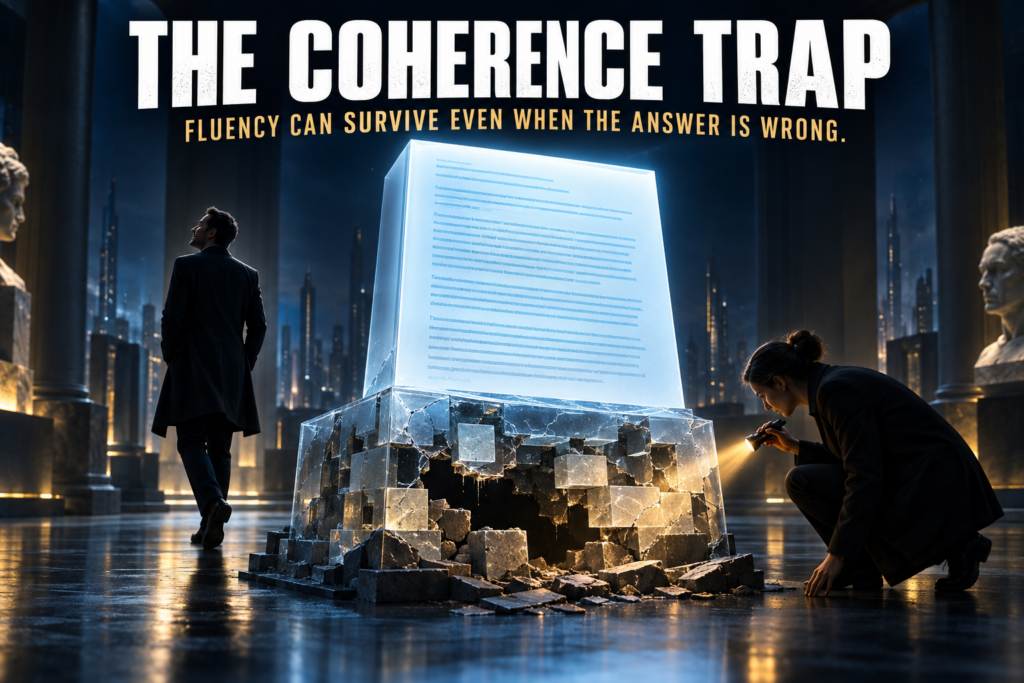
People who don’t develop it rely on coherence as a proxy for correctness. If it reads well, it must be right.
That assumption is increasingly risky. Modern AI systems are optimized to produce fluent, plausible responses—and that fluency can persist even when the answer is wrong.8
Fluency is the feature. It is also the trap.
The Real Divide
The emerging divide isn’t between people who use AI and people who don’t. It’s between people who use AI to avoid thinking and people who use it to think better.
Both groups will continue to produce work. Both will appear productive.
Over time, the gap will widen. One group becomes faster at completing tasks they don’t fully understand. The other becomes better at understanding problems they’ve never seen before.
The long-term impact of AI won’t be measured by productivity gains. It will be measured by what happens to human capability underneath them.
If we optimize for output, we will get more of it. Faster. Cheaper. Cleaner.
But if we stop building the ability to question, adapt, and understand, we risk trading competence for convenience.
AI isn’t replacing thinking. It’s making it optional.
And that may be the most consequential shift of all.
Notes
1. Elizabeth L. Bjork and Robert A. Bjork, “Making Things Hard on Yourself, but in a Good Way: Creating Desirable Difficulties to Enhance Learning” (2011).
2. Henry L. Roediger III and Jeffrey D. Karpicke, “Test-Enhanced Learning: Taking Memory Tests Improves Long-Term Retention” (2006).
3. Asher Koriat and Robert A. Bjork, “Illusions of Competence in Monitoring One’s Knowledge During Study” (2005).
4. Hao-Ping Lee et al., “The Impact of Generative AI on Critical Thinking: Self-Reported Reductions in Cognitive Effort and Confidence Effects From a Survey of Knowledge Workers” (2025).
5. K. Anders Ericsson, Ralf Th. Krampe, and Clemens Tesch-Römer, “The Role of Deliberate Practice in the Acquisition of Expert Performance” (1993).
6. Carol S. Dweck, Mindset: The New Psychology of Success (2006).
7. Sam Wineburg, Sarah McGrew, Joel Breakstone, and Teresa Ortega, “Evaluating Information: The Cornerstone of Civic Online Reasoning” (2016).
8. OpenAI, “GPT-4 Technical Report” (2023).
