

BETWEENPLAYS | TECHNOLOGY, BUSINESS & GEOPOLITICS
November 13, 2026 | Investigative News
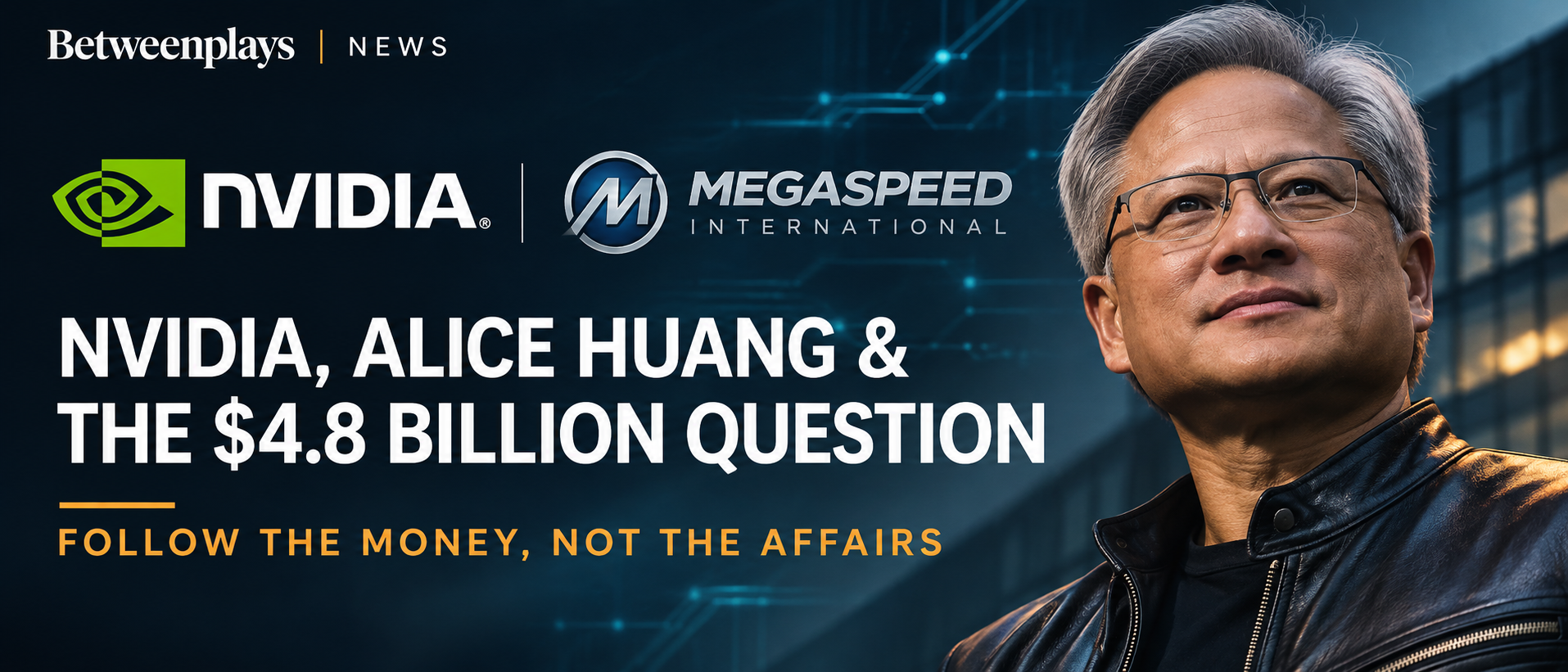
Three reported affairs. A $4.8 billion AI-chip relationship. A $300 million insider stock sale. A CEO’s resignation. Now, congressional scrutiny. Behind Nvidia’s leadership crisis lies a much larger question: What do the financial records actually reveal?
On November 12, Nvidia founder Jensen Huang resigned as CEO, president and director, with CFO Colette Kress appointed interim CEO.
His departure followed revelations of three reported extramarital relationships, including one with Chinese businesswoman Alice Huang, also known as Huang Le, whose connections to Nvidia extended well beyond their personal relationship.
Three Affairs, Two Nvidia Employees
Reuters reported that two of the relationships involved Nvidia employees. One was Kimberly Powell, Nvidia’s vice president of healthcare and the second employee has not been publicly identified (at the time of his writing).
No substantiated public evidence links either employee to espionage, unlawful chip transfers or related wrongdoing. Whether investigators questioned either employee about those matters has not been publicly disclosed.
Regardless relationships involving a CEO and company employees raise legitimate questions about executive oversight, conflicts of interest and corporate governance.
The $4.8 Billion Nvidia Connection to Megaspeed and Alice Huang
Alice Huang previously held senior positions at Shanghai Hexi Investment Management before becoming controlling shareholder and managing director of Singapore-based Megaspeed International.
The company, previously known as 7Road International, became an official Nvidia Cloud Partner in 2023.
According to Axios, citing Associated Press reporting, Megaspeed purchased more than US$4.8 billion in Nvidia chips over approximately two years. That type of financial expansion is extraordinary.
According to Singapore corporate records examined by Reuters:
- 2023 assets: US$33 million
- 2024 assets: Approximately US$3 billion
- 2024 revenue: US$294 million, compared with zero in 2023
- 2024 net loss: Approximately US$20 million
Megaspeed became wholly owned by another Singapore company, Swiftdata, in November 2023, after Alice Huang’s formal management tenure.
Questions surrounding ultimate beneficial ownership, the source of its financing and the end users of its computing infrastructure remain important.
Singapore’s Investigation: What Was Established
On November 12, Singapore’s Ministry of Home Affairs released its findings of its investigation into the situation. Authorities investigated potential false declarations concerning server purchases and shipments.
Investigators concluded there was insufficient evidence to establish Alice Huang’s involvement in the suspected declaration offences. However, police determined that she had knowingly provided inaccurate information about her role in Megaspeed. She received a stern warning, was barred from re-entering Singapore and she left the country in February 2026.
Singapore explicitly confirmed that its investigation of Alice Huang was not an espionage investigation. Investigations involving Megaspeed and six other individuals are ongoing.
Congress Demands Answers: Jensen Huang Agrees to Appear
On November 12, House Foreign Affairs Committee Chairman Brian Mast confirmed that Jensen Huang had agreed in principle to appear before congressional investigators. The request originated with three Republican committee chairs: Mast, John Moolenaar of the House Select Committee on China, and Rick Crawford of the House Intelligence Committee.
Lawmakers want answers about Nvidia’s security protocols, Jensen Huang’s interactions with Alice Huang and whether sensitive American AI technology or national-security interests were compromised.
The controversy has now reached Capitol Hill.
The original congressional request proposed November 18, raising the possibility of an appearance as early as next week. However, a second formal request issued November 12 seeks a closed-door, transcribed interview on December 1, with lawmakers threatening a subpoena if Huang does not comply. A final appearance date has not yet been publicly confirmed.
Senate Banking Committee Chairman Tim Scott has separately requested testimony from Jensen Huang and Commerce Secretary Howard Lutnick over national-security and export-control concerns, according to Reuters.
The congressional inquiry could establish a more detailed public record of what Nvidia executives and U.S. officials knew, and when.
Were Nvidia Shares Sold Before the Scandal?
Public SEC filings confirm substantial insider selling before Huang’s November 8 admission.
On September 18, Nvidia director Mark Stevens sold 1,366,000 shares worth approximately US$300.15 million through trusts.
The transaction was disclosed in an official SEC Form 4 filing. The filing did not identify the sales as transactions under a Rule 10b5-1 trading plan.
The transaction’s size and timing warrant examination, but neither establishes illegal insider trading.
Then, on November 5, three days before Huang’s public acknowledgment, Nvidia shares fell 9.26% to $181.60, amid exceptionally heavy trading. However, market reporting that day documented a broader semiconductor selloff, with AMD falling more than 17% and the Nasdaq Composite declining 5.52%.
There is no established evidence that the November 5 selling was driven by advance knowledge of Huang’s admission. Questions concerning Megaspeed’s chip exports were already public before the November revelations.
On November 9, Nvidia and Huang were named in a shareholder securities lawsuit reported by Reuters. The complaint alleges misleading disclosures concerning Huang’s relationship with Alice Huang and associated business risks. It is not a finding of securities fraud or insider trading.
Espionage Allegations Remain Unproven
On November 12, U.S. Attorney General Todd Blanche confirmed that the Justice Department had reached no conclusion about whether Alice Huang was working for Chinese intelligence.
China denies the allegations. Megaspeed denies improper chip diversion, while Nvidia has said it has no reason to believe its trade secrets or national-security information were compromised.
Where are we now?
The personal scandal has dominated the headlines and is more distraction than anything else. However the publicly available corporate records tell a more consequential story.
There are serious things to investigate further, and one would expect the coming weeks and months will reveal much more than the public knows now. How did a multibillion-dollar AI hardware relationship become established. How did corporate assets of Megaspeed grow so fast in a short window of time? Where is/was the beneficial ownership? There were significant insider stock sales. Who financed Megaspeed’s expansion? Who ultimately controlled its operations? Who received access to restricted computing capacity? What did Nvidia’s leadership and board know? And were its financial disclosures and internal safeguards adequate?
Now, an abrupt leadership transition and congressional scrutiny involving multiple committees.
While it’s a lot to take in none of these facts, individually or collectively, proves espionage, insider trading or unlawful technology transfers, but they raise questions that deserve documented answers.
Congress now has an opportunity to put these questions directly to Huang and the officials responsible for overseeing America’s advanced technology exports. The central issue is not who Jensen Huang had relationships with; it is whether personal access, corporate influence and billions of dollars in strategically sensitive technology intersected in ways that compromised accountability.
The evidence—not the scandal—must determine the answer.
BETWEENPLAYS NEWS | November 13, 2026
This article draws on publicly accessible SEC filings, congressional documents, Singapore government statements, company announcements and independent reporting. Allegations and unresolved investigations are explicitly distinguished from established findings.
