

This article was co-written with Andrea Turno
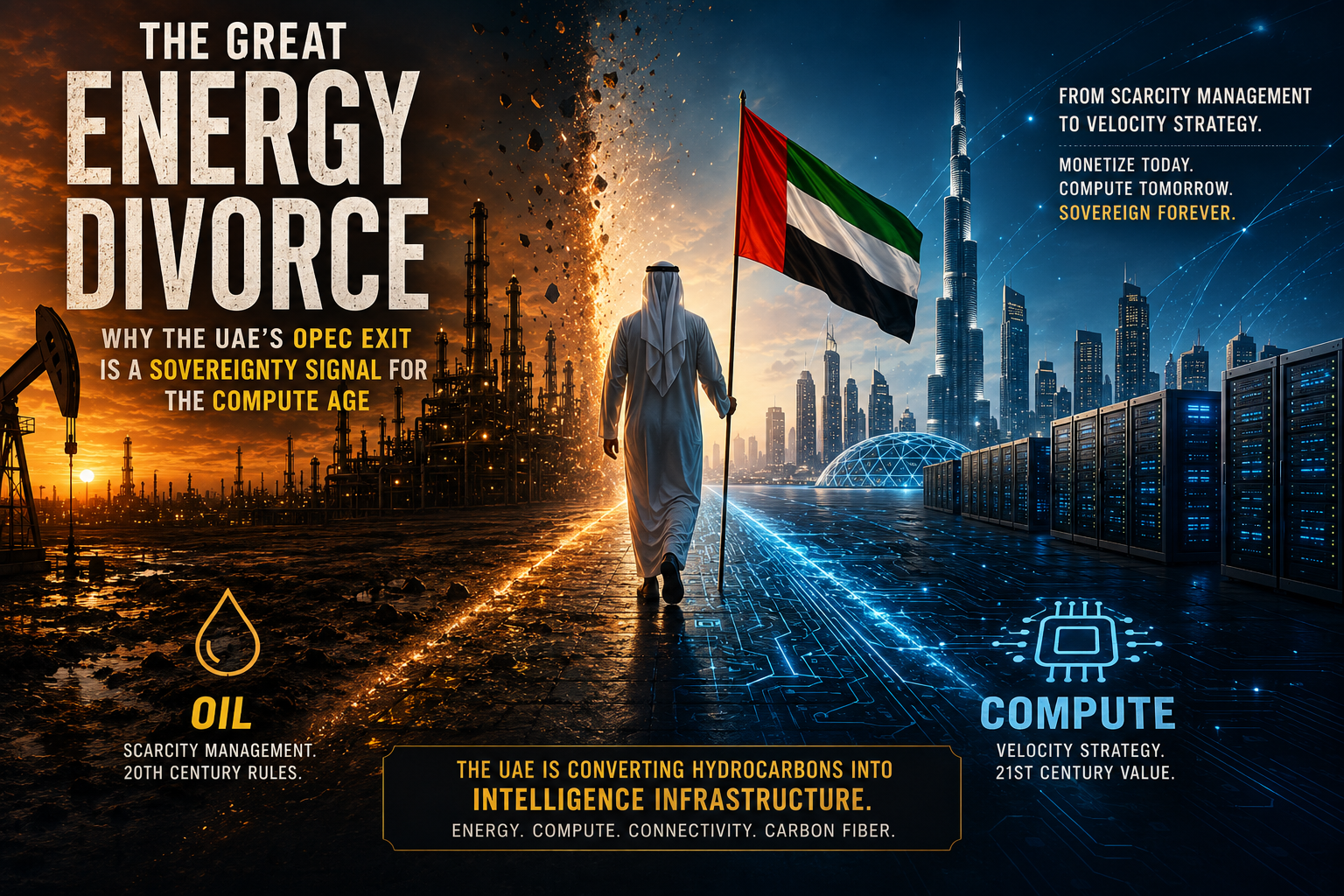
For decades, the global financial system has been held together by a “handshake in the sand.” We called it the Petrodollar—a symbiotic loop where the U.S. provided security and the Gulf provided liquid energy, all settled in the world’s reserve currency. This arrangement served as the ultimate kinetic anchor for the U.S. Dollar. However, the announcement that the United Arab Emirates (UAE) is exiting OPEC and OPEC+ effective May 1, 2026, is not merely a trade dispute; it is a formal filing for divorce.
If my previous analysis on The Great AI Decoupling explored the race for sustainable intelligence, this shift is about Sustainable Sovereignty. The UAE is leaving because the cartel’s rules—designed for 20th-century scarcity—are fundamentally incompatible with the next century of value creation.
Strategic Timing: Why Now?
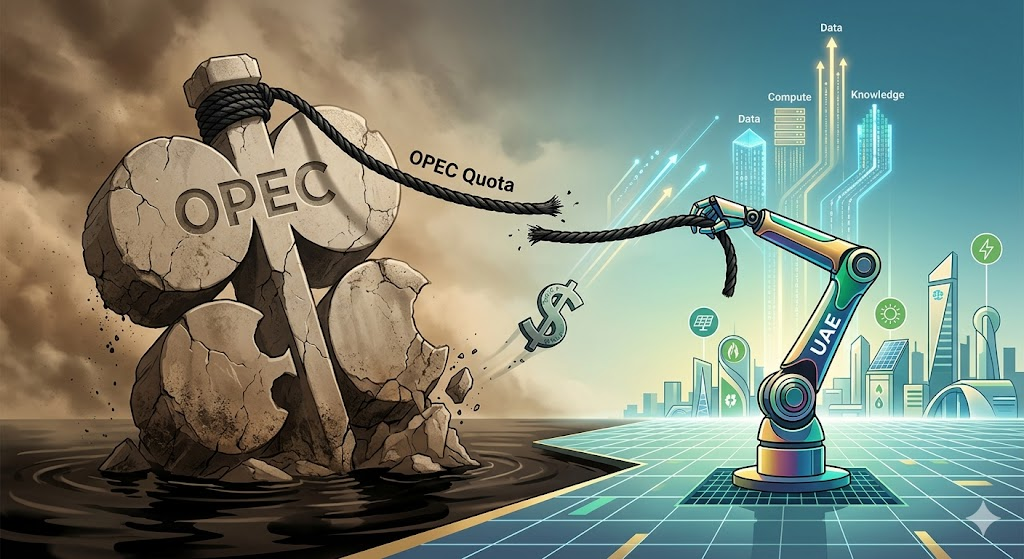
While the timing has surprised analysts, it is a calculated response to a “black swan” environment. The U.S.-Israel-Iran conflict has upended the old order. With the Strait of Hormuz currently impassable and the World Bank warning of the largest oil supply loss on record, the UAE has realized that “scarcity management” is a luxury they can no longer afford.
The UAE is moving now because they have finished their homework. After investing $150 billion to reach a 5 million barrel-per-day (mb/d) capacity, they refuse to leave 30% of that infrastructure “shut-in” to support the fiscal deficits of other nations. They are transitioning from a Price Strategy to a Velocity Strategy. In a world of deep geothermal baseload and sodium-ion breakthroughs, the UAE views oil as a “decaying asset”. The mandate is clear: monetize every molecule as fast as possible to fund the transition into an AI-Oasis.
Sovereign Energy Free Agents: The AI-Compute Connection
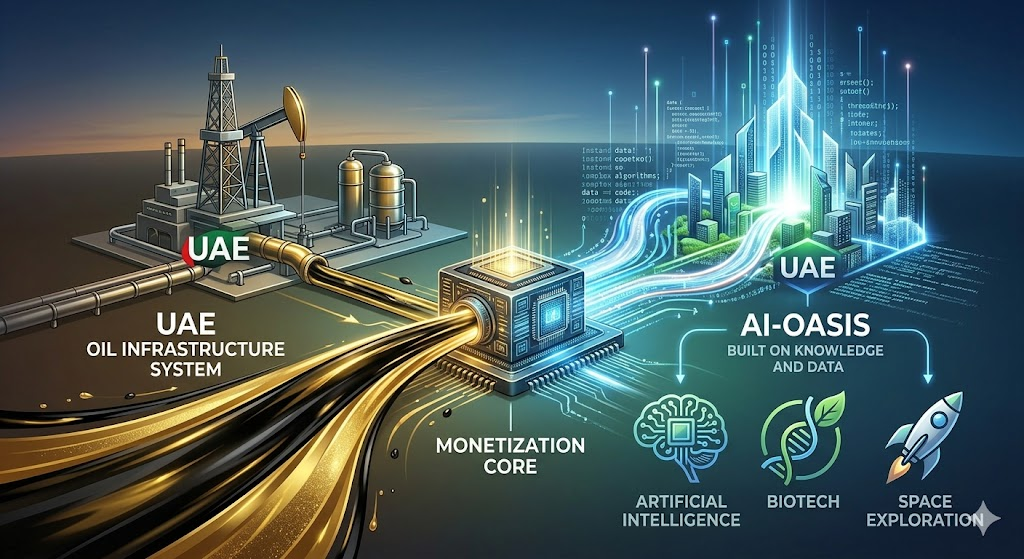
The UAE is positioning itself for the next few centuries by becoming a “Sovereign Energy Free Agent”. In the new paradigm, energy is no longer just an export; it is the raw material for Compute. By breaking free from OPEC quotas, the UAE gains the autonomy to divert its energy and capital directly into the 21st century’s most valuable commodities: Compute, Connectivity, and Carbon Fiber.
This is a play for technological dominance. With one of the lowest “break-even” prices in the world—nearly half that of Saudi Arabia—the UAE can remain profitable even if oil prices plummet, allowing them to outlast their peers and aggressively fund their sovereign AI clusters. They are trading a seat in a fading 20th-century oil cartel for a lead role in the global frontier of intelligence.
The Anti-Fragile Bypass: Fujairah vs. The Red Sea
Geography is being re-engineered to survive regional volatility. While the world watches the Strait of Hormuz, the UAE has built the anti-fragile alternative:
- The Fujairah Bypass: By routing flows through the East Coast, the UAE is the only Gulf player that can guarantee supply to the Indian Ocean when the Strait of Hormuz is “dark”.
- Regional Competition: It is important to note that the UAE is not the only player seeking an exit strategy. Saudi Arabia has its own route to the Red Sea, bypassing the Strait to reach Western markets. However, the UAE’s strategy is uniquely tied to the IMEC Corridor, positioning itself as the “Physical Router” between India’s manufacturing surge and Europe’s energy needs.
The Treasury Trap: Three Risks to U.S. Debt
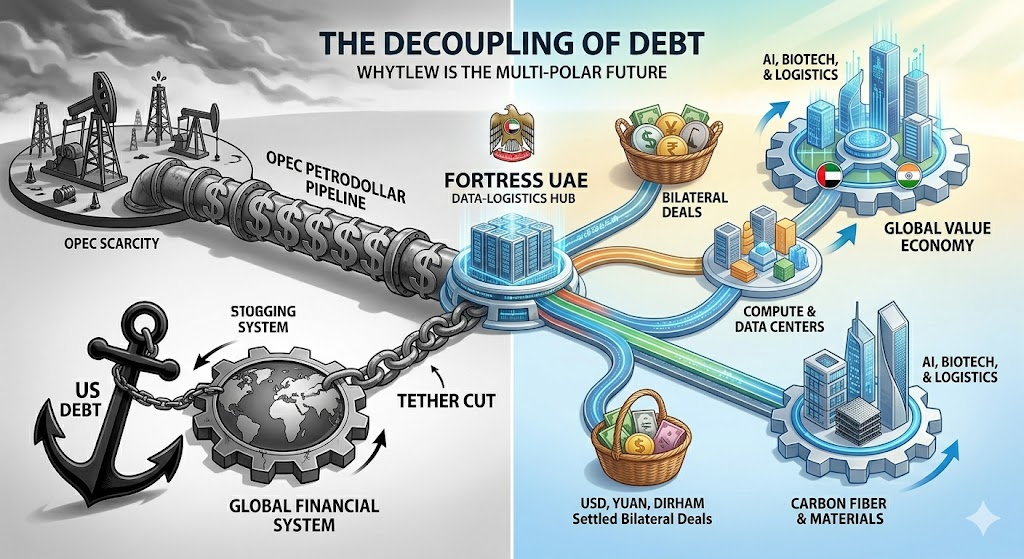
As an investor, the most critical takeaway is the decoupling of debt. The Petrodollar was essentially a subsidy for U.S. debt, but that subsidy is now being withdrawn. If other Gulf nations follow the UAE’s lead—a move some analysts call “the beginning of the end for OPEC”—we face three systemic risks:
- The End of the Symbiotic Loop: The mechanism where oil profits were automatically recycled into U.S. Treasuries is breaking. The “Petrodollar” anchor is being lifted, ending decades of forced demand for U.S. debt.
- The Rise of Multipolar Settlement: The UAE is signaling a move toward multipolar settlement, selling energy in Yuan or Dirhams when it suits their strategic interests. This reduces the global necessity for Dollar reserves.
- Capital Flight to Compute: Wealth that once sat in liquid U.S. paper is being aggressively reallocated into domestic AI infrastructure and sovereign technological power.
Conclusion
The UAE has recognized that the future belongs to those who control the infrastructure of intelligence, not just the reserves of the past. For the U.S., the divorce is real, and the subsidy is gone. For the UAE, the future is officially unpegged, fueled by the velocity of a decaying asset being converted into the permanent asset of the future: Intelligence.
Public Reference & Source Materials
1. Official State Statements & News
- WAM (Emirates News Agency): “UAE announces decision to exit OPEC & OPEC+” (April 28, 2026) – https://www.wam.ae/en/article/bzxzuh7-uae-announces-decision-exit-opec-opec+
- Argus Media: “UAE to exit Opec, pursue independent output policy” (April 28, 2026) – https://www.argusmedia.com/en/news-and-insights/latest-market-news/2819870-uae-to-exit-opec-pursue-independent-output-policy
- BBC News: “United Arab Emirates to quit oil cartel Opec” (April 28, 2026) – https://www.bbc.com/news/articles/c070v1v4revo
2. Market Analysis & Geopolitics
- Gulf News: “5 reasons why UAE’s exit from OPEC, OPEC+ is big for world markets, oil prices” (April 28, 2026) – https://gulfnews.com/business/energy/5-reasons-why-uaes-exit-from-opec-opec-is-big-for-world-markets-oil-prices-1.500522136
- The Motley Fool: “The UAE is Leaving OPEC. Here’s What It Means for the Global Oil Market” (April 28, 2026) – https://www.fool.com/investing/2026/04/28/the-uae-is-leaving-opec-heres-what-it-means-for-th/
- Disruption Banking: “UAE Exits OPEC: Accelerating Petrodollar Decline” (April 28, 2026) – https://www.disruptionbanking.com/2026/04/28/uae-exits-opec-2026/
3. Comparative Frameworks (Author Context)
- Between Plays: “The Great AI Decoupling” – https://betweenplays.com/the-great-ai-decoupling-beyond-the-nuclear-band-aid-to-the-era-of-sustainable-intelligence/
- Between Plays: “The Solid State Seduction” – https://betweenplays.com/the-solid-state-seduction/
