
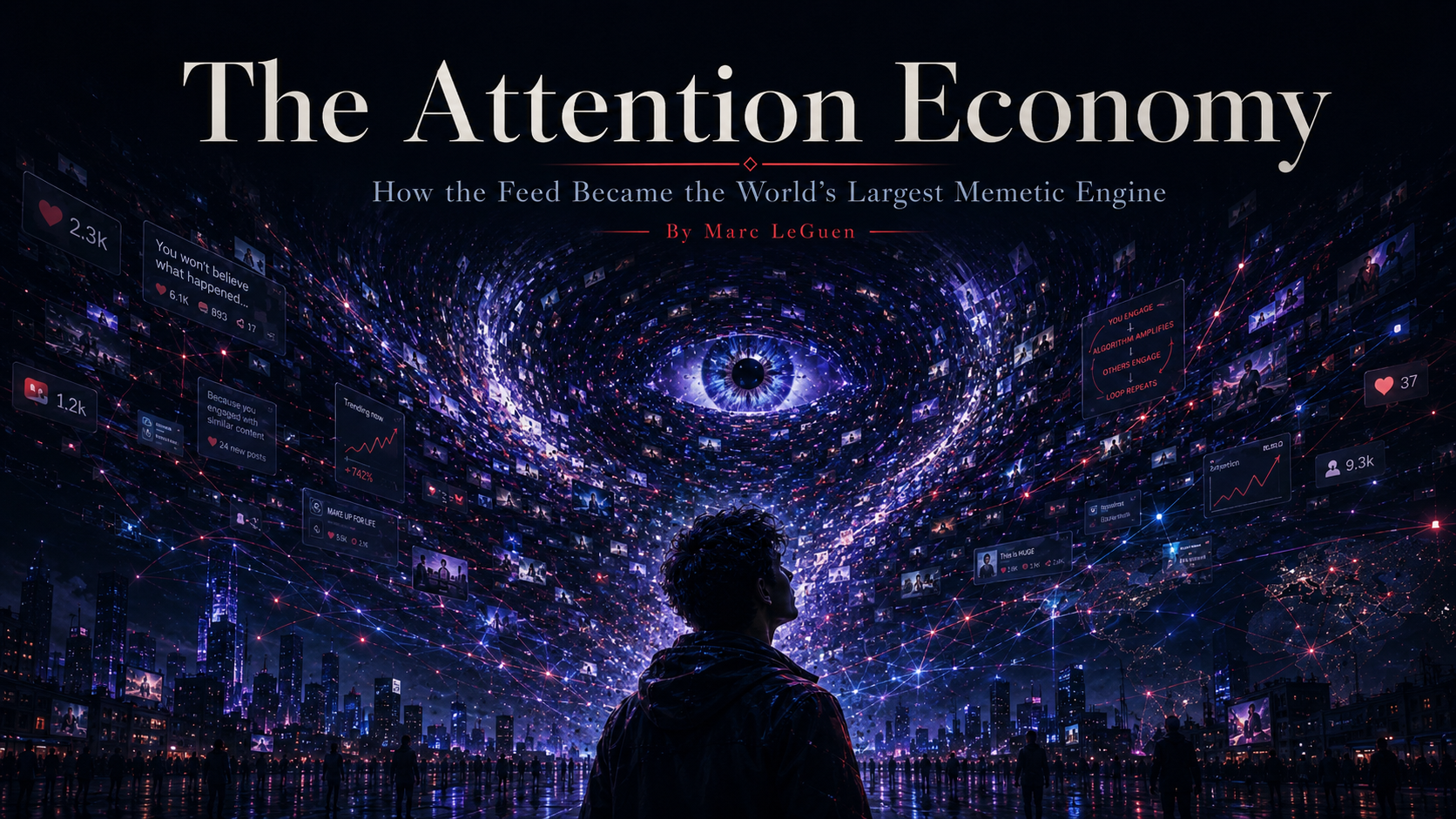

How the Feed Became the World’s Largest Memetic Engine
We Didn’t Get Snow Crash. We Got Something Stranger.
In Neal Stephenson’s 1992 novel Snow Crash, the world is threatened by a virus unlike any that came before it.
Snow Crash is both a computer virus and a cognitive virus. It spreads through information itself, exploiting vulnerabilities deep within the human mind. In the novel, exposure to certain patterns, symbols, and linguistic structures can bypass rational thought and directly alter behavior. It is a terrifying concept because it suggests that the right message, delivered in the right way, can function like malicious code.
Three decades later, we have not witnessed anything quite so dramatic. Nobody is collapsing into a neurological fugue state after viewing a TikTok video. There is no master virus hidden in a meme, no linguistic exploit capable of instantly rewriting human consciousness, yet, reading Snow Crash today can feel unsettlingly familiar.
Stephenson did not accurately predict social media. What he anticipated was something deeper: a world in which information itself becomes the primary battleground for influence, attention, and power. The internet that emerged in the 2020s is not the world of Snow Crash, but it often behaves as though it is running a diluted version of the same experiment. The result is not a single engineered virus. It is something stranger: a global ecosystem that continuously discovers, amplifies, and distributes the most psychologically contagious ideas on Earth.
The Rise of Information Pathogens
Long before social media platforms existed, evolutionary biologist Richard Dawkins introduced the concept of the meme. In his 1976 book The Selfish Gene, Dawkins proposed that ideas spread through cultures in ways analogous to genes spreading through populations.
Successful ideas replicate. Unsuccessful ideas disappear.
Stephenson took this concept and turned it into science fiction. Snow Crash imagines an information pathogen so effective that it hijacks the human operating system itself. Modern social media platforms do not spread ideas because they are true. They spread ideas because they are effective at replication.
A funny video gets shared because it is funny. A shocking headline gets shared because it provokes outrage. A conspiracy theory gets shared because it offers certainty in a confusing world. The underlying mechanism is not truth-seeking. It is transmission. In many ways, social media functions as the largest memetic selection engine ever created.
“Modern social media does not need ideas to be true. It only needs them to be transmissible.”
Every day, billions of users collectively perform a vast experiment. They click, like, share, repost, comment, watch, pause, skip, save, and react. Algorithms observe these behaviors and learn which pieces of information travel furthest and fastest. Content that triggers stronger emotional reactions receives more engagement. More engagement produces more visibility. More visibility produces more engagement.
Ideas that reproduce effectively survive. Ideas that do not reproduce disappear. That process should sound familiar to anyone who has read Snow Crash.
Algorithms as an Evolutionary Pressure
The common narrative about social media is that algorithms manipulate people. While there is some truth to that, the reality is more complicated.
Most recommendation systems are not designed, at least explicitly, to radicalize users, create political polarization, or spread misinformation. They are designed to maximize engagement. The distinction matters. The algorithms are not asking whether a post is true. They are asking whether someone is likely to interact with it.
The recommendation feed is not just a feature. It is the operating layer of the modern attention economy. Platforms increasingly describe these systems as ranking engines that learn from interaction signals: what users watch, skip, like, share, search, follow, and return to.
“The feed is not just a feature. It is the operating layer of the modern attention economy.”
That means attention is not merely captured after content is published. It is measured, predicted, ranked, and fed back into the system as training data. Unfortunately, human psychology contains certain predictable vulnerabilities.
Researchers have documented negativity bias, the tendency to pay greater attention to threats than opportunities. We are more likely to notice alarming information than reassuring information. We are more likely to remember criticism than praise. We are more likely to engage with outrage than nuance. This makes evolutionary sense. Our ancestors who ignored potential dangers did not tend to leave descendants.
The problem is that social media platforms transform these ancient instincts into engagement signals. A platform does not need to understand politics to discover that outrage travels faster than moderation. It does not need to understand psychology to discover that certainty outperforms ambiguity. It merely needs to observe what people click.
The result resembles a kind of natural selection for ideas. The content most likely to survive is not necessarily the most accurate or useful. It is the content best adapted to the environment; and the environment rewards attention.
The Fragmentation of Shared Reality
One of the most remarkable aspects of Snow Crash is its concern with linguistic fragmentation. Stephenson imagined a world where common narratives had broken down and competing systems of meaning fought for dominance. At the time, this seemed like speculative exaggeration. Today, it feels almost mundane.
For much of the twentieth century, large populations consumed information from a relatively small number of sources. Newspapers, television networks, radio stations, and magazines created a common informational environment. People disagreed about the meaning of events, but they often shared a common understanding of what events had occurred.
Two individuals living in the same city can now inhabit entirely different information ecosystems. Their feeds are shaped by distinct networks, interests, identities, and engagement histories. Over time, those feeds become increasingly personalized.
The result is not merely disagreement.
It is divergence.

Different groups encounter different facts, different narratives, different authorities, and different interpretations of reality itself.
This matters because social platforms are no longer marginal channels. A significant share of the public now gets at least some of its news through social media, where information is filtered not only by editorial judgment, but by ranking systems, creator incentives, peer networks, and engagement loops.
Social media changed that.
In Snow Crash, the threat is a virus that bypasses conscious thought. In modern social media, the threat is more subtle. People are not forced into a single worldview. Instead, they are gently guided toward different worlds altogether.
The Invisible Arms Race
Perhaps Stephenson’s most accurate prediction was not technological but economic. Much like today, in Snow Crash, information is power. That statement has become almost cliché, but the modern internet reveals just how literal it has become.
Technology companies compete for attention. Advertisers purchase attention. Political campaigns seek attention. Influencers monetize attention. Media organizations survive or fail based on attention. Attention has become one of the defining economic resources of the twenty-first century, and the consequences are profound.
Every participant in the digital ecosystem faces pressure to produce content that captures and retains human focus. Journalists compete against creators. Creators compete against brands. Brands compete against friends and family.
The competition never ends. And because attention is finite, every actor is incentivized to become slightly more compelling, slightly more emotional, slightly more provocative than the alternatives. The system does not require malicious intent, it merely requires competition.
Over time, this creates an arms race in which the most psychologically effective messages gain disproportionate visibility. Stephenson imagined an engineered cognitive weapon. Reality built a marketplace that rewards many of the same characteristics.
The AI Escalation
The next version of this ecosystem will not be built only by human creators. Generative AI makes it possible to produce synthetic persuasion at industrial scale: endless variations of headlines, images, videos, comments, replies, avatars, influencers, and personalities, each optimized for a different audience. The memetic engine is no longer limited by human production capacity.
That changes the nature of the attention economy. The original social web rewarded whomever could produce the most contagious message. The AI-driven social web may reward whomever can generate, test, and adapt the most contagious variations of that message at the highest speed. The danger is not simply that artificial intelligence will create more fake content.

The deeper issue is that AI can make the attention system more adaptive. It can help content evolve faster. It can tune language, emotion, imagery, rhythm, and timing. It can manufacture the appearance of consensus. It can simulate intimacy. It can create the illusion that a message is coming from everywhere at once. This does not mean every AI-generated message is harmful. Like social media itself, generative AI has legitimate and valuable uses. It can expand creativity, improve access to information, help small publishers compete, and give individuals tools once reserved for large media organizations.
But when synthetic content enters an attention market already optimized for emotional replication, the stakes change. The question is no longer whether bad information can spread. The question is what happens when information can be produced, personalized, and adapted faster than human institutions can evaluate it.
The Comparison Isn’t Perfect
It would be easy to overstate the analogy. Social media is not Snow Crash. The fictional virus is centralized, deliberate, and deterministic. It directly compromises human cognition in a way that resembles malicious software.
Real people possess agency. They think critically. They reject ideas. They change their minds. They form communities that challenge misinformation and encourage skepticism. Most users are not passive victims of algorithmic manipulation. Moreover, social media has produced enormous benefits. It has connected families across continents, enabled grassroots political movements, democratized publishing, accelerated scientific communication, and provided platforms for voices that traditional institutions often ignored.
Any serious analysis must acknowledge both sides of the ledger. The danger lies not in believing social media is evil. The danger lies in misunderstanding how it works. The platforms do not need to brainwash people to influence society. They merely need to alter the incentives governing which ideas receive amplification. Small changes at planetary scale can have enormous consequences.
That is why governments and regulators have begun treating large platforms less like ordinary websites and more like systemic infrastructure. The European Union’s Digital Services Act, for example, places special obligations on very large online platforms and search engines because their design choices can create social risks at scale. That does not solve the problem, but it does recognize the category.
Prediction Beneath the Prediction
The most fascinating thing about revisiting Snow Crash today is realizing that Stephenson’s greatest insight was not the virus itself. It was the recognition that information systems would eventually become powerful enough to compete with governments, religions, educational institutions, and traditional media for control of human attention.
That competition is now underway.
When billions of people spend hours each day inside algorithmically curated environments, those environments inevitably shape culture. They influence beliefs, identities, relationships, and collective behavior. They become part of the machinery through which societies understand themselves. The internet did not create a literal cognitive virus. What it created was a global infrastructure capable of identifying the most contagious ideas ever produced and distributing them at unprecedented speed.
Stephenson imagined a weaponized information pathogen that could hijack the mind. Reality delivered something less dramatic but potentially more consequential: a system that continuously evolves ideas according to their ability to capture attention.
The difference matters.
“A virus can be defeated. An ecosystem becomes part of the environment.”
Unlike the characters in Snow Crash, we are not fighting an attack from outside the system. We are participants inside it, clicking, sharing, reacting, posting, prompting, and training it every day. That may be the most Stephenson-like twist of all. Not that someone built the virus.
Billions of us helped build the conditions under which one was no longer necessary.
References
Dawkins, R. (1976). The Selfish Gene. Oxford University Press.
Oxford University Press — The Selfish Gene
European Commission. (n.d.). Digital Services Act: Very large online platforms and search engines. European Commission.
European Commission — DSA: Very Large Online Platforms and Search Engines
Meta Transparency Center. (2025). Facebook Feed Recommendations AI system. Meta.
Meta Transparency Center — Facebook Feed Recommendations AI System
Pew Research Center. (2025). Social Media and News Fact Sheet. Pew Research Center.
Pew Research Center — Social Media and News Fact Sheet
Stanford Institute for Human-Centered Artificial Intelligence. (2025). The 2025 AI Index Report. Stanford University.
Stanford HAI — 2025 AI Index Report
Stephenson, N. (1992). Snow Crash. Bantam Books.
Penguin Random House — Snow Crash by Neal Stephenson
TikTok Newsroom. (2020). How TikTok recommends videos #ForYou. TikTok.
TikTok Newsroom — How TikTok Recommends Videos #ForYou
Vaish, A., Grossmann, T., & Woodward, A. (2008). Not all emotions are created equal: The negativity bias in social-emotional development. Psychological Bulletin, 134(3), 383–403.
PubMed — Not All Emotions Are Created Equal
Vosoughi, S., Roy, D., & Aral, S. (2018). The spread of true and false news online. Science, 359(6380), 1146–1151.
Science — The Spread of True and False News Online
World Economic Forum. (2024). The Global Risks Report 2024. World Economic Forum.
World Economic Forum — Global Risks Report 2024
Zuboff, S. (2019). The Age of Surveillance Capitalism: The Fight for a Human Future at the New Frontier of Power. PublicAffairs.
PublicAffairs — The Age of Surveillance Capitalism
